Design Services


2026 FIFA World Cup: How Do Membrane-Structure Stadiums Empower the Global Football Extravaganza?
The 2026 FIFA World Cup—hosted jointly by the United States, Canada, and Mexico—is set to break records with its expansive, multi-nation format and a brand-new tournament structure. A key highlight of this edition is the decision to forgo the construction of any new venues, relying instead on existing, state-of-the-art stadiums. Among these, six stadiums featuring membrane structures stand out; with their lightweight domed designs, intelligent retractable systems, stunning interplay of light and shadow, and all-weather adaptability, they serve as the core venues for the tournament. In this feature, Zhongke Membrane explores these six unique membrane-structured stadiums, analyzing how such technology empowers elite international football and showcasing the innovative applications and distinct value of modern membrane engineering in large-scale sports architecture.
I. Mercedes-Benz Stadium: A Paradigm of Dynamic Architectural Aesthetics
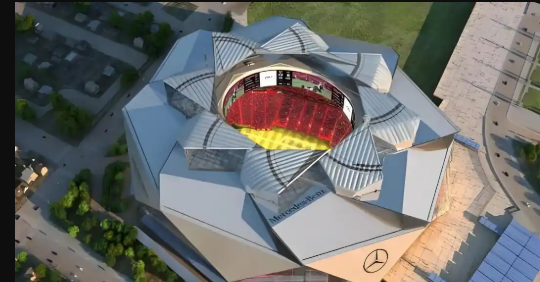
Opened in 2017 in Atlanta, USA, the Mercedes-Benz Stadium is a benchmark for innovation in North American sports architecture. Globally renowned for its “petal-like” retractable membrane roof, the stadium’s unique dynamic design and exceptional spatial efficiency have earned it a place as a primary venue for the 2026 World Cup, offering the flexibility to reconfigure the pitch and seating layouts to suit specific match requirements.
The roof consists of eight triangular, lightweight membrane panels, each mounted on an independent truss-and-rail system. These panels operate in synchronization, capable of opening or closing completely in just eight minutes with precise, controlled movement. Weighing only half as much as a glass roof of equivalent area, the structure is nonetheless engineered to withstand high wind loads and pressure—combining the advantages of a lightweight build, high structural strength, and excellent light transmission. During the World Cup, the roof can be adjusted rapidly to accommodate Atlanta’s variable weather: when fully open, the stadium connects directly to the open sky, seamlessly blending the pitch with the urban horizon; when fully closed, it creates a completely enclosed environment, supported by a climate-control system that ensures the tournament can proceed regardless of external conditions. This dynamic, moving dome creates a visual spectacle, lending a unique architectural aesthetic to every World Cup match hosted within.
II. SoFi Stadium: A Futuristic Landmark for Sporting Events
Located in Los Angeles, USA, and completed in 2020, SoFi Stadium stands as one of the newest and most expensive premier venues for this World Cup. With a staggering $5.5 billion investment, it ranks among the world’s top sports complexes. The stadium seamlessly blends minimalist architectural aesthetics with cutting-edge membrane structure technology. Hosting eight high-profile matches—including group stage games, the Round of 16, and the quarterfinals—it serves as a core venue for the tournament.
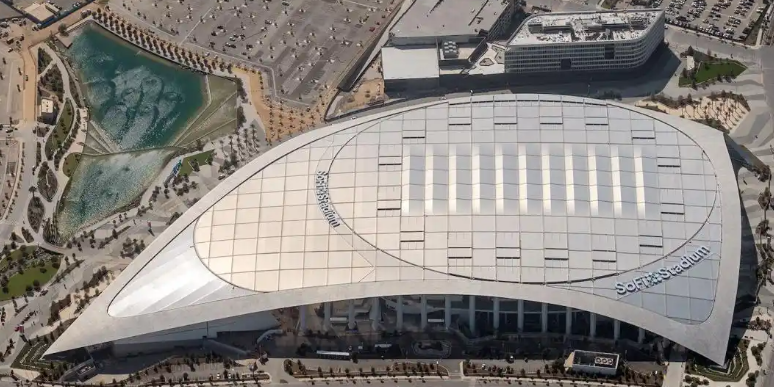
The stadium’s most iconic feature is its fixed ETFE membrane roof. Eschewing traditional, heavy steel-structured roofing, it utilizes a lightweight, tensioned membrane system that offers exceptional light transmission. This allows natural light to diffuse evenly across every corner of the pitch, eliminating shadows and creating optimal lighting conditions for high-definition broadcasting and player performance. The fixed membrane roof incorporates a specialized ventilation design, ensuring efficient airflow without the need for a retractable mechanism—a solution perfectly suited to Los Angeles’s mild climate. Furthermore, the design significantly reduces the structure’s overall weight; combined with a sunken layout, it minimizes the visual dominance such a massive structure might otherwise exert on the city skyline, creating the impression of a dome hovering above the pitch. Inside, the stadium is equipped with a 360-degree, dual-sided 4K suspended giant screen and a comprehensive audiovisual system. Together with the natural illumination provided by the translucent membrane roof, these elements deliver an immersive viewing experience—a fusion of natural light and advanced technology—making it a world-class football arena that excels in aesthetics, innovation, and functionality.
III. AT&T Stadium: A Benchmark for Long-Span Sports Architecture
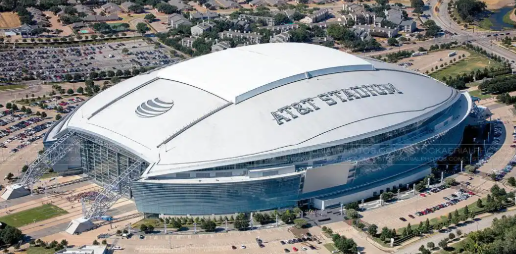
Located in Arlington (Dallas), Texas, AT&T Stadium is one of the largest membrane-structured sports venues in North America. Renowned for its massive, long-span retractable membrane roof and exceptional structural stability, it frequently hosts top-tier sporting events. As a key venue for the 2026 FIFA World Cup—jointly hosted by the United States, Canada, and Mexico—the stadium leverages its sophisticated membrane structural system and comprehensive event infrastructure to host high-intensity World Cup matches.
The venue features a long-span, retractable tensioned-membrane roof, composed of two colossal membrane panels. Supported by 64 high-precision drive motors and an arched truss structure, the roof can transition between fully open and fully closed positions in just 12 minutes, making it one of the most stable and largest-spanning retractable membrane roofs in the world. The membrane material offers wind resistance, waterproofing, thermal insulation, and noise reduction, enabling it to withstand the extreme weather fluctuations common in Dallas. When closed, it quickly creates a climate-controlled environment with stable temperature and humidity; when opened, it fully exposes the arena to the sky, restoring the authentic atmosphere of an open-air football match.
IV. NRG Stadium: A Model for All-Weather Event Spaces
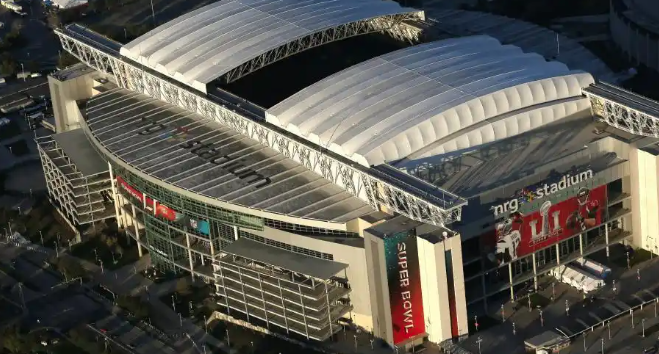
Opened in 2002 in Houston, Texas, NRG Stadium was among the first NFL venues to implement a large-scale, lightweight retractable membrane roof. Following several rounds of upgrades and renovations—which significantly enhanced both its versatility for various events and its structural stability—the stadium was selected as a host venue for the 2026 FIFA World Cup. Its high-speed retractable roof and climate-controlled interior are perfectly suited to Houston’s hot and humid climate, ensuring an optimal environment for World Cup matches. The stadium’s retractable roof consists of a steel-hinged framework clad in a semi-translucent membrane. The roof is divided into two large sections that open toward the center of the arena. These sections are supported by massive trusses—each measuring 206 meters in length—which allow the roof to slide; when retracted, the roof panels are stowed above the stands at either end, while in the fully closed position, they completely cover the playing field. The entire opening and closing sequence takes just 7 minutes. Given the hot and humid summer climate in Houston, the membrane roof remains closed throughout all World Cup matches. The semi-translucent material filters out intense sunlight while allowing soft, natural light to permeate the interior. Complemented by a 2,500-ton central air-conditioning system, the stadium maintains a constant temperature of 24°C, significantly reducing the physical toll of the hot, humid weather on players and ensuring a high level of competitive play during intense football matches.
V. BC Place Stadium: A Landmark Stadium with a Retractable Cable-Supported Membrane Roof
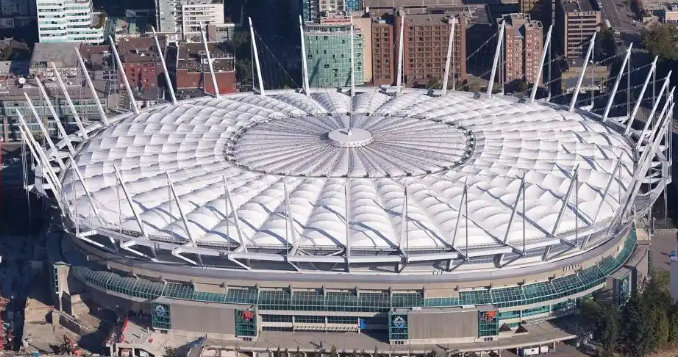
Located in downtown Vancouver—a city framed by mountains and the sea—BC Place Stadium is a landmark membrane-structure venue in North America. Originally built in 1983, it underwent a major renovation in 2011, during which a retractable, cable-supported membrane roof was installed. Thanks to its exceptional engineering design and adaptability to the local climate, the stadium will host seven matches during the 2026 World Cup, serving as the primary venue for Canada’s portion of the tournament. The stadium’s intelligent retractable roof system consists of 36 retractable inner-ring units and 36 fixed outer-ring units. Powered by a sophisticated cable-supported tension system, the roof can transition between fully open and fully closed states within 20 minutes—a feature perfectly suited to Vancouver’s rainy and snowy maritime climate. When the dome is open, the distant snow-capped mountains and the ocean breeze from the Pacific flow into the arena, giving spectators the sensation of being in an open-air venue nestled between mountains and sea. When closed, the membrane structure creates a fully sealed enclosure, shielding the interior from Vancouver’s precipitation and ensuring that events can proceed smoothly regardless of the weather.
VI. Akron Stadium: An Ecological Sports Space in Harmony with Nature
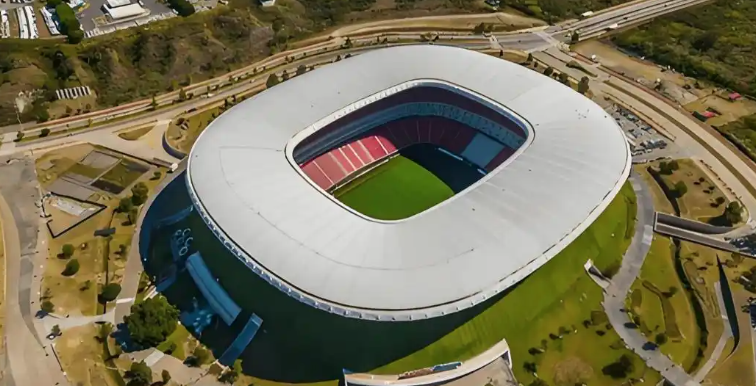
Located in Guadalajara, Mexico, Akron Stadium serves as a key venue for the 2024 FIFA World Cup (hosted by the U.S., Canada, and Mexico). Its design centers on a minimalist, lightweight, partially-covering membrane roof, which incorporates the sleek, dynamic style characteristic of Latin American architecture—a perfect fit for the high-energy atmosphere of football.
Unlike the fully retractable or fully enclosed membrane roofs seen in the U.S. and Canadian venues, Akron Stadium features a targeted, partial membrane roof designed to protect the stands and the playing field. By combining lightweight tensioned membrane materials with a minimalist steel framework, the design creates an airy, transparent roof system. The membrane’s high weather resistance is well-suited to the hot, sun-drenched climate of western Mexico; it effectively blocks ultraviolet rays and lowers the temperature on the pitch, while still allowing for ample natural ventilation and daylight—balancing the needs for shade, rain protection, and airflow. The minimalist membrane design eschews superfluous decoration in favor of pure functionality, aligning with the core competitive spirit of football. The light, white membrane dome, set against the backdrop of the green pitch and the Latin American urban landscape, creates a highly distinctive visual identity—showcasing both the practical value of modern membrane architecture and the unique aesthetic of Latin American sports facilities. The 2026 FIFA World Cup—hosted across the United States, Canada, and Mexico—features six stadiums with membrane structures. Spanning diverse climates and urban landscapes, these venues utilize distinct membrane designs while maintaining a consistent, world-class standard for hosting elite sporting events. Together, they exemplify the core trends in modern sports architecture: lightweight construction, intelligent systems, ecological integration, and context-driven design.
Beneath these expansive membrane roofs, the venues host more than just high-stakes football matches; they represent a profound fusion of architectural technology and sports culture. Membrane structure technology grants these World Cup arenas all-weather operational capabilities, immersive spectator experiences, and a unique visual aesthetic. In doing so, the 2026 World Cup stands as a landmark event defined by modern architectural innovation, setting a new benchmark for the construction and operation of large-scale sports venues worldwide.
If you are interested in membrane-structured stadiums or have specific project requirements, please leave a comment below or send us a direct message. Zhongke Membrane looks forward to connecting with you to explore further engineering case studies and the practical value of these solutions.