Design Services



Zoned Tensile Shade: Strategic HDPE & PVC Fabric Guide
An effective shading strategy is not defined by the total area covered, but by whether each shaded zone is precisely tailored to the needs of its users. The redevelopment of the Beenleigh Aquatic Centre in Queensland, Australia, illustrates this principle perfectly. Rather than employing a one-size-fits-all structure, the design weaves a multi-layered shading network—carefully adapted to the distinct character of the swimming pools, lawns, picnic areas, and children’s zones—ensuring that every activity finds its own ideal patch of shade.

For the main pool area, the design utilizes a cantilevered PVC membrane roof. The rafters, shaped like hockey sticks, allow for an expansive span that provides shade stretching from the water’s surface across to the poolside seating and circulation paths. With no columns along the pool deck, the lifeguards’ sightlines remain completely unobstructed, while swimmers looking upward see only the fluid, sweeping curve of the membrane. This large-span, column-free solution addresses critical requirements for competitive swimming and safety: clear visibility, comprehensive coverage, and a structure that never interferes with movement.

The children’s splash zone follows an entirely different logic. The introduction of purple and green HDPE mesh membranes instantly transforms the atmosphere. The woven structure of the HDPE allows for free airflow, eliminating the stifling heat often associated with solid, impermeable materials. Sunlight filters through the mesh, breaking into dappled patterns that dance across the children—a playful interaction of light and shadow. Furthermore, HDPE is naturally resistant to UV radiation, moisture, and chlorine-rich environments, making it perfectly suited for the mist-filled, humid conditions of a poolside setting. For children, the vibrant, rainbow-like canopy of purple and green holds a natural, magnetic appeal—once they step inside, they never want to leave.

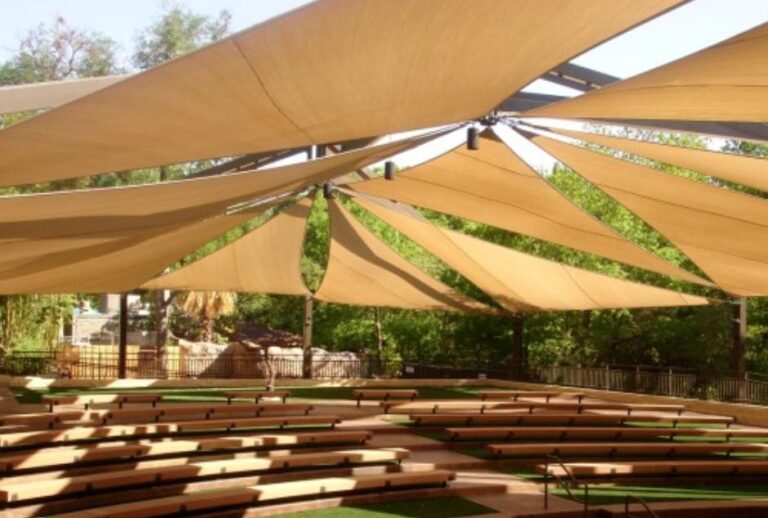
For the lawns and picnic areas, the design employs central-column membrane structures, creating open, airy spaces shaded from all sides. With their doubly-curved geometric forms, these structures resemble soft, sculptural elements emerging from the ground; as sunlight passes through the gaps in the membrane, it casts ever-changing patterns of light and shadow across the grass. People sit beneath the membrane structures—picnicking, chatting, or simply zoning out. Sheltered from above yet open on all sides, the space allows the gaze to travel freely toward the distant water and sky.

More than a dozen independent structures are scattered across the site, yet the arrangement feels far from chaotic. A consistent white PVC membrane unifies the various elements, acting like an invisible thread that strings together disparate beads into a cohesive whole. Interspersed among these are HDPE mesh structures in shades of purple and green, each lending a distinct character to its respective zone.

The brilliance of this project lies in its rejection of a “one-size-fits-all” approach. Where the pool area demands expansive, unobstructed views, cantilevered structures are employed; the children’s zone, requiring a sense of playfulness, features colorful mesh; and the picnic area, which calls for flexibility and openness, utilizes a central-column design. Each structural form is a precise response to a specific functional need, rather than a mere replication of a single, universal blueprint.

From a community perspective, this multifaceted design transforms the very nature of the aquatic center. It is no longer just a place to swim; people are now inclined to spend an entire afternoon here—picnicking under the canopy after a swim, children playing amidst colorful patterns of light and shadow, and the elderly conversing in the breezy, shaded spaces. A facility once defined by a single function has evolved into a vibrant social hub for the community. At its core, excellent public space design achieves something both simple and profoundly challenging: it does not provide the exact same shelter for everyone, but rather ensures that each individual finds the specific kind of shade they need.