Design Services
Overlooked Metal Hardware in HDPE Tensile Shade Systems
In a complete HDPE mesh shade system, the membrane material is only one component; the service life of the entire system is often determined by the metal connectors and fasteners—elements that account for a relatively small portion of the total project cost. Many project procurers focus exclusively on comparing the specifications of the membrane material while neglecting the selection of hardware. This oversight frequently leads to corrosion or structural failure, causing the entire shade system to reach the end of its functional life prematurely.

Requirements for the corrosion resistance of metal hardware vary significantly by location. In typical inland urban environments, 304-grade stainless steel is generally sufficient for long-term use. However, in coastal areas, the air is rich in chloride ions, which can cause pitting and rust spots on standard 304 stainless steel; therefore, projects in such regions must utilize 316-grade stainless steel.

If standard carbon steel is used to cut costs—even when hot-dip galvanized—it will quickly corrode upon long-term outdoor exposure, especially when subjected to rain or moisture. Rust can spread from rings and cables to the edges of the membrane, leaving stubborn brown stains on the mesh fabric that are difficult to remove, while simultaneously compromising the integrity of the woven fibers.

Metal rings and reinforced stitched webbing are the critical load-bearing points of the membrane. Since the entire tension of a mesh shade system is concentrated on these corner rings, using undersized hardware—or failing to incorporate high-strength polyester reinforcement webbing—can cause the rings to tear away from the membrane under the stress of repeated wind-induced vibration.

Many low-cost products feature rings pressed directly into holes punched into the mesh, lacking any additional reinforcement webbing. This concentrates all the stress on the mesh weave itself, making the material highly prone to tearing at these points. Proper manufacturing standards dictate that reinforced webbing should be heat-welded or stitched along all load-bearing edges before the metal rings are installed, effectively distributing the applied stress.

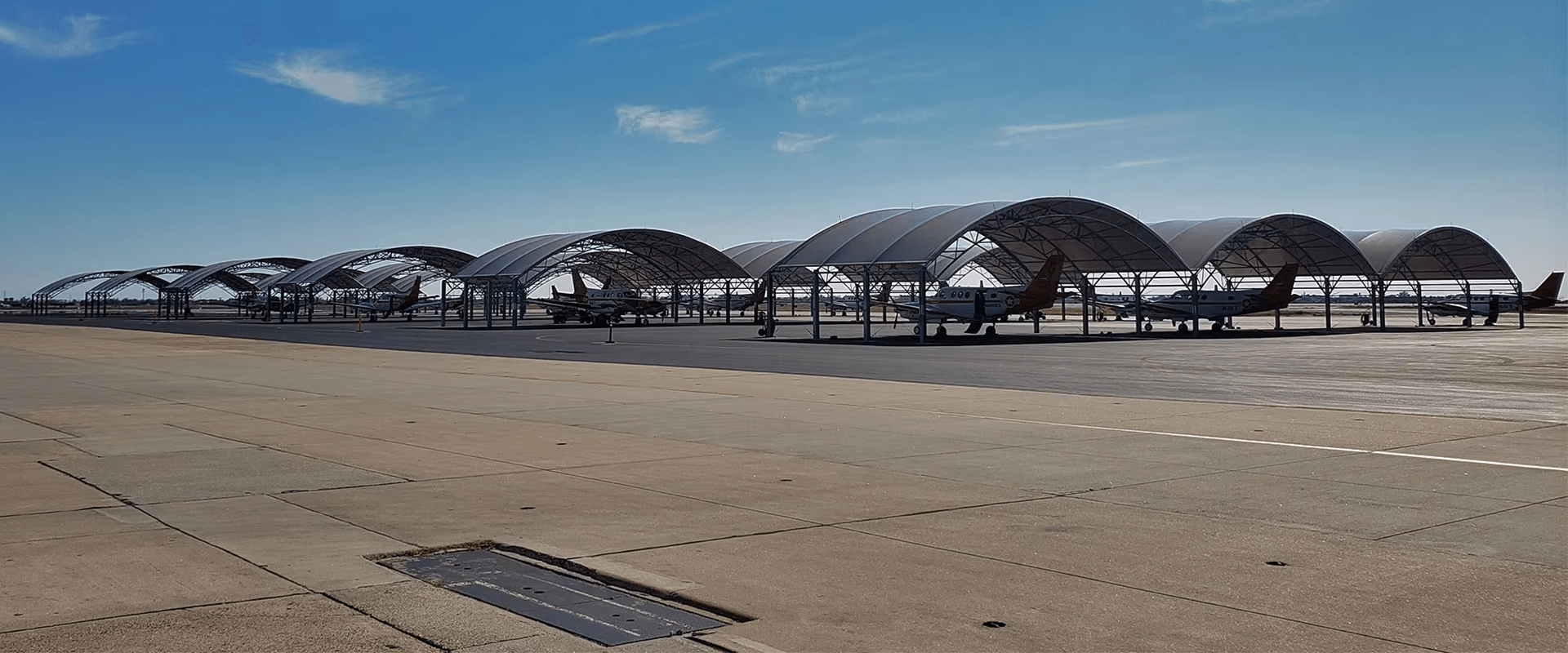
Steel columns, diagonal braces, and rigging components are equally critical and should not be overlooked. For complex, non-standard forms—such as “swallow-wing” tensioned structures or large-scale cable-net canopies—the steel framework must account for fluctuating wind loads; relying solely on static load calculations is insufficient.

Rigging components, such as adjustment screws and turnbuckles, must provide ample travel range to allow for re-tensioning during later stages. Furthermore, all hardware surfaces should undergo passivation. It is essential to eliminate any sharp edges or corners, as these could otherwise cause continuous friction and abrasion against the membrane material when the structure vibrates under wind loads.

During the project bidding and design phases, the technical specifications for hardware—including material grades, component dimensions, and reinforcement stitching methods—must be clearly defined. Vague terms like “stainless steel hardware” are inadequate; specific material grades, fastener specifications, and precise reinforcement techniques must be explicitly stated. Even the highest-quality HDPE mesh fabric cannot withstand the cascading damage caused by inferior hardware. Though small, these components serve as the critical foundation for the safety and durability of the entire shading system.