Design Services


Safety & Fire Code Limits of HDPE Mesh Shade Canopies
As mesh membranes become increasingly common in parks, campus grounds, and commercial districts, safety and fire protection in public spaces have emerged as critical considerations during the design phase. HDPE (high-density polyethylene) is a polymeric material; however, many designers lack a clear understanding of its combustion characteristics and safety limitations. This often leads to two extremes: either completely overlooking fire safety requirements or categorically rejecting the use of the material in areas with high pedestrian density.

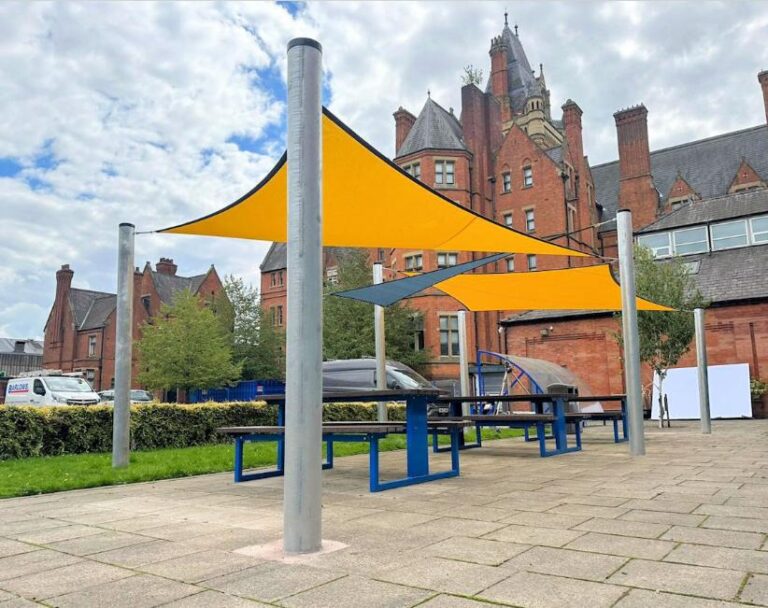
HDPE mesh membranes used in landscape applications are combustible polymeric fabrics. They melt and shrink when exposed to open flames; they do not function as fire-resistant building components and cannot serve as fire-rated partitions. Nevertheless, they are typically employed in semi-outdoor, open-air environments—functioning as outdoor shading structures—which fundamentally distinguishes them from the ceilings or roofing components found in enclosed indoor spaces. In these semi-open settings, smoke and heat can dissipate rapidly, preventing the accumulation of high-temperature smoke—an inherent characteristic of their typical application environment.

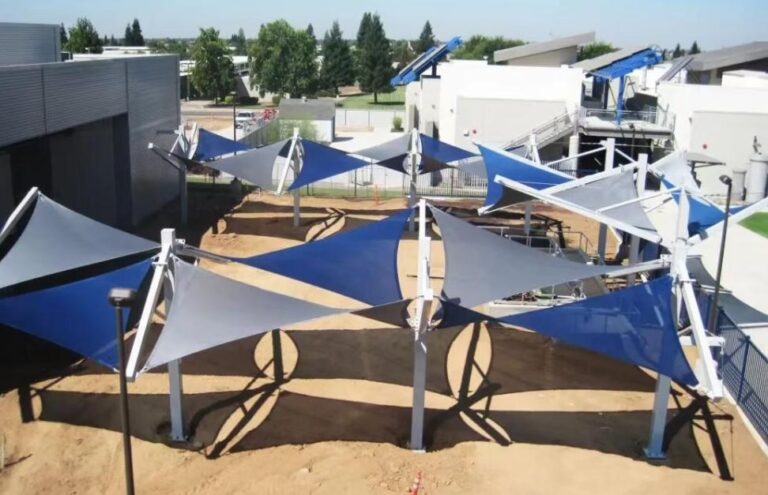
In areas with high concentrations of people, large-scale, tightly packed installations should be avoided. Extensive, oversized mesh canopies should be divided into smaller, discrete units with appropriate gaps, ensuring that the overhead space is not completely sealed and that there is a clear path for smoke to escape upward.

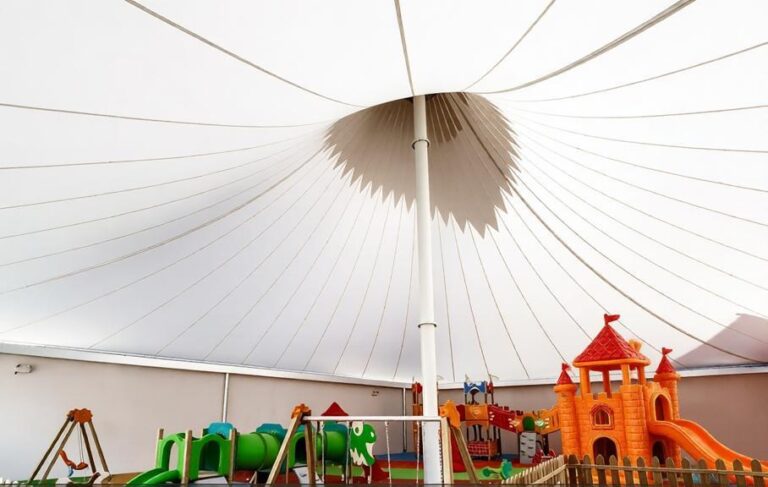
For children’s play areas, priority should be given to fabrics that have obtained relevant fire-retardant certifications. Furthermore, these installations must be kept away from open flames; a sufficient safety buffer should be maintained between mesh shading units and features such as barbecue grills or other outdoor open-flame equipment to prevent sparks from igniting the membrane.

Additionally, the risk of material fragmentation must be addressed. Mesh membranes produced from low-grade recycled materials may degrade over time, shedding small debris—a potential safety hazard in settings like school campuses or children’s playgrounds. Consequently, public projects must exclusively utilize engineering-grade fabrics manufactured from virgin polymer resins (with color integrated into the raw material). Specifications should clearly define UV-resistance standards and warranty periods, while explicitly excluding products made from recycled materials. Once the material reaches the end of its service life due to degradation, it must be replaced in its entirety; it should not remain in use beyond its intended lifespan.

It is also necessary to clarify the scope of application for relevant standards. HDPE mesh shade sails are classified as landscape tensioned shading structures, not as building roofs. While the full suite of fire safety regulations for building roofs cannot be applied directly, fire safety requirements cannot be disregarded either. During the design phase, it is essential to proactively consult local fire safety authorities to define the scope of application—specifically addressing the segmentation of units, required safety distances from fire sources, and the flame-retardant specifications for the fabric.

Every material has its own operational limits, and HDPE mesh membranes are no exception. By acknowledging the inherent properties of the material—neither overstating its performance nor dismissing it entirely—and employing it strictly within the parameters defined by established standards, one can effectively balance aesthetic landscape design with the fundamental requirements for public safety.