Design Services
Why Lifecycle Cost Matters More Than HDPE Mesh Price
In urban renewal, industrial park enhancement, and commercial facility upgrades, many projects fall into a common trap: focusing solely on the initial unit price of materials while overlooking the hidden costs associated with long-term operation, maintenance, future iterations, and structural reinforcement.

In reality, the core competitive advantage of construction-grade HDPE mesh membranes extends far beyond aesthetics and shading. They offer exceptional value throughout their entire lifecycle; their lightweight, low-maintenance, and adaptable nature significantly reduces the costs of both renovating and operating public outdoor spaces.

Regarding initial construction costs, the ultra-lightweight properties of HDPE mesh membranes eliminate the need for extensive civil engineering and structural investment. Traditional concrete pergolas or metal awnings are extremely heavy, requiring deep foundations, reinforced steel frameworks, and the strengthening of existing structures—all of which drive up costs for earthworks, materials, and labor, while also extending construction timelines and causing significant site disruption.

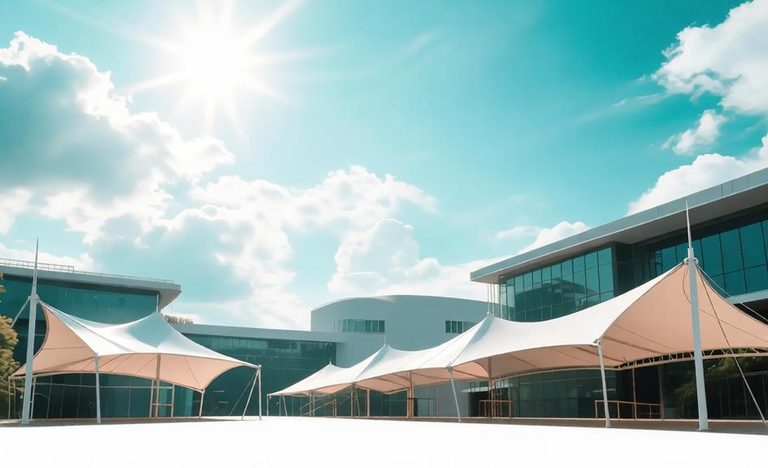
In contrast, mesh membranes are exceptionally lightweight. They can be anchored to lightweight steel structures, existing building columns, or other site features, bypassing the need for major civil works. This drastically shortens construction schedules and lowers upfront investment—making them particularly well-suited for the renovation of existing sites.

The cost advantages become even more pronounced during the operational phase. Engineered HDPE mesh membranes utilize solution-dyed fibers and UV-resistant additives, ensuring superior weatherability. They remain resistant to fading, chalking, and embrittlement even after long-term outdoor exposure, eliminating the need for periodic repainting or intensive refurbishment.

The membrane surface is smooth and hydrophobic, allowing rainwater to naturally wash away accumulated dust. This removes the need for frequent, high-altitude cleaning, resulting in significant savings on labor and maintenance supplies. Furthermore, the material is corrosion-resistant and impervious to acids, alkalis, moisture, and mild salt spray. It performs reliably over the long term across a wide range of urban outdoor environments.

Unlike rigid structures, which are difficult to modify, mesh membrane shading systems offer the flexibility required for future adaptations and upgrades. Should the site’s functions be adjusted or its landscape upgraded in the future, the membrane surfaces can be individually removed, replaced, or relocated, while the primary steel framework remains reusable. This eliminates the need for complete demolition and reconstruction, significantly reducing both resource waste and the costs associated with future modifications.

Unlike rigid shading structures—which entail a one-time investment and remain fixed in place permanently—the modular design of mesh membrane structures is perfectly suited to the dynamic, evolving nature of urban spaces.
While initial costs are a consideration in the short term, long-term value is what truly matters. Moving beyond a narrow focus on the price of individual materials, HDPE mesh membrane structures offer a full-lifecycle advantage: they require minimal civil engineering and maintenance, support iterative updates, and boast a long service life. This makes them a highly cost-effective choice for enhancing shading and quality in urban public spaces—delivering a blend of aesthetic appeal, practicality, and economic efficiency for a wide range of municipal, campus, and commercial projects.