Design Services
Vibrant PVC Tensile Shade Sails for Retail Corridors
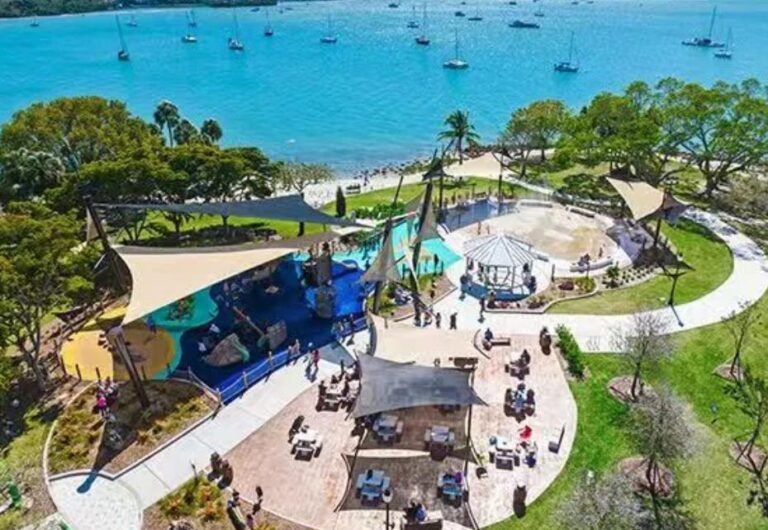
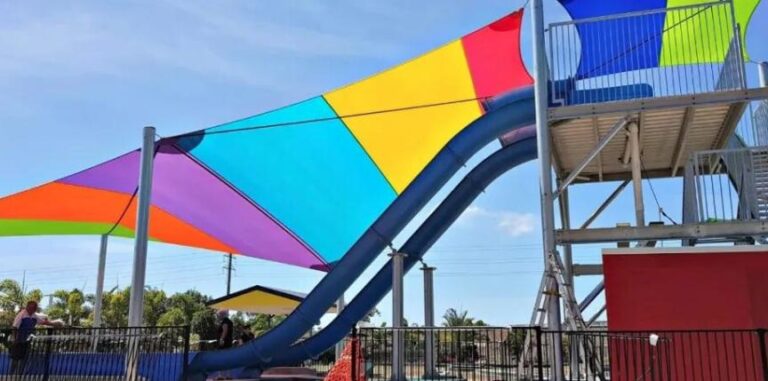
In outdoor public corridors—such as those found in coastal commercial districts or pedestrian leisure zones—rigid, heavy-looking canopies with monotonous colors often fail to harmonize with the relaxed, vibrant atmosphere of the area. PVC-coated tensioned shade sails, a classic form of flexible membrane structure, have become a popular shading solution for street-side corridors, courtyard walkways, and coastal commercial strips. Their appeal lies in their diverse color palette, lightweight and fluid curved forms, and their dual functionality as both sun and rain protection. The series of multi-colored, interconnected shade sails shown here serves as a prime example of this type of membrane structure successfully implemented in a commercial setting.

The primary material for these shade sails is a PVC-coated fabric, consisting of a high-strength polyester base layer with a PVC coating applied to both sides. These membranes can be custom-manufactured with multi-colored, segmented, or spliced designs—a distinct advantage over standard single-color PVC membranes or porous HDPE shade netting. Unlike HDPE mesh, which provides shade but lacks waterproofing, these PVC-coated membranes are dense and impermeable. When tensioned, they form a doubly-curved surface; the pre-tensioning creates a natural slope that allows rainwater to flow toward designated low points for drainage, preventing the accumulation of water. This dual-purpose design ensures that commercial corridors remain functional year-round, providing shade on sunny days and shelter from the rain.

Structurally, these installations are classified as small-scale tensioned membrane structures. They are anchored to existing building walls or support columns and integrated with stainless steel cables, tensioning hardware, and aluminum edge profiles. Through precise pre-tensioning, the membrane is pulled taut to create a graceful, naturally stretched, and subtly concave curved form. By arranging multiple shade sails in a continuous sequence along the street, they connect to form a cohesive, unified canopy system for the corridor. The curved geometry inherently offers excellent aerodynamic properties, allowing wind pressure to dissipate along the membrane surface. This reduces structural loads during high-wind conditions, making it well-suited for the windy environments often found in coastal areas. Furthermore, the material is extremely lightweight, exerting minimal load on existing building walls. Consequently, it can be installed in many renovation projects for older commercial districts without the need for extensive structural reinforcement, ensuring a convenient, time-efficient upgrade process.

The most striking feature of colored PVC membranes is their vibrant visual expression. Unlike the limited color palettes of traditional roofing materials, PVC membranes can be customized with specific color zones during production. The design shown—featuring horizontal stripes of green, orange, and yellow—boasts high color saturation, creating a crisp, layered appearance under daylight. At night, when illuminated by street lighting, the colored membrane softly diffuses the light, enhancing the relaxed atmosphere of the commercial district. High-quality colored PVC membranes are formulated with UV-resistant additives and can be finished with a self-cleaning PVDF topcoat. This layer blocks the vast majority of ultraviolet radiation, delaying aging and fading. The low surface tension of the self-cleaning coating prevents dust from adhering; when it rains, water flows across the surface, washing away most accumulated dust. This significantly reduces the need for ongoing cleaning and maintenance—an ideal solution for busy commercial areas where frequent upkeep is impractical.

Naturally, there are clear limitations to the use of tensioned colored PVC membrane shading structures. As a flexible tensioned system, it demands high precision during both the form-finding and installation (tensioning) phases. Insufficient tension can lead to a slack membrane surface where water may pool, while excessive tension can cause stress concentrations at the corner joints, accelerating the risk of tearing. The weather-resistant lifespan of PVC membranes is shorter than that of PTFE membranes; in coastal environments exposed to salt spray, a standard commercial colored PVC membrane—with proper maintenance—typically has a service life of 8 to 12 years. This makes it well-suited for commercial districts that require periodic landscape and aesthetic updates, rather than for permanent building roofs intended for extremely long-term use. The hardware components must be made of 316-grade stainless steel to resist corrosion from coastal salt spray and prevent the failure of cables and fasteners due to rust.

In terms of landscape design, these continuous PVC-membrane shade sails transcend the conventional view of shading elements as purely functional components, transforming the shading system into a centerpiece of the urban landscape. The linearly arranged, colorful curved surfaces create a gentle transition between building facades, softening the rigid appearance of solid walls and tiled roofs. The membrane material offers a degree of translucency—unlike steel-roofed structures, which can leave walkways feeling dark and oppressive—allowing for soft, diffused light underneath that ensures a comfortable experience for pedestrians.

Overall, PVC-membrane tensioned shade sails represent a flexible shading solution that strikes an excellent balance between functionality, cost, and landscape aesthetics. They are well-suited for pedestrian streets, coastal towns, courtyards of guesthouses, and outdoor dining areas, offering distinct advantages for projects that require vibrant color, rapid renovation, and effective protection from sun and rain. With careful attention to wind-load calculations, drainage-oriented form-finding, and the selection of corrosion-resistant hardware, these systems can provide long-term, reliable performance—creating dynamic, lightweight, and fluid semi-outdoor corridors for commercial spaces.