Design Services


How Coal Storage Air Domes Solve Dust & Pollution Issues
Enclosing coal storage areas is one of the most practical applications for air-supported structures. Whether at coal-fired power plants, coal mines, ports, or coal washing facilities, any site with open-air coal piles faces the problem of fugitive dust. Environmental authorities mandate enclosure, while nearby residents frequently lodge complaints. In recent years, air-supported structures have become increasingly common in these settings—for a simple reason: they offer a relatively low-cost solution to eliminate dust pollution at its source.
I. What are the problems with leaving coal storage areas unenclosed?
Dust pollution is the most significant headache for coal yards. When the wind blows, coal dust disperses, affecting areas several kilometers away. Residents are forced to keep their windows closed and cannot hang laundry outside, leading to a barrage of complaints to environmental protection agencies. These agencies impose strict dust control requirements; failure to meet them can result in fines, production limits, or even mandatory shutdowns for rectification.
Beyond environmental pressures, coal yards also suffer direct economic losses. Dispersed coal dust represents a tangible loss of inventory. Furthermore, rain can soak the coal piles, reducing their calorific value and creating leachate that requires treatment. Given these combined challenges, enclosing coal storage areas has become a necessity.
II. How do air-supported structures solve these issues?
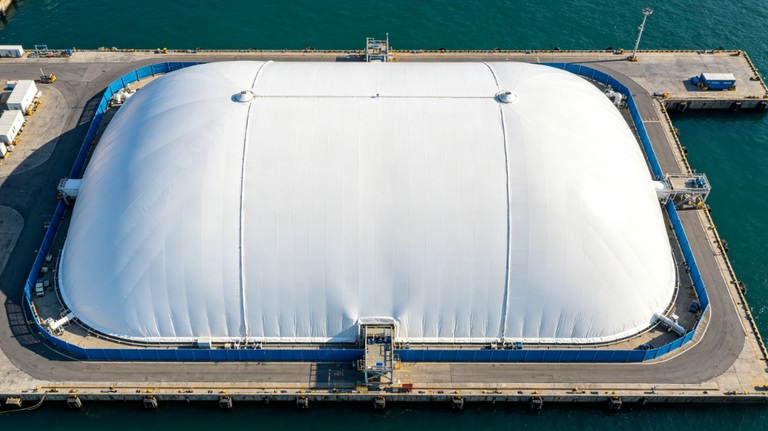
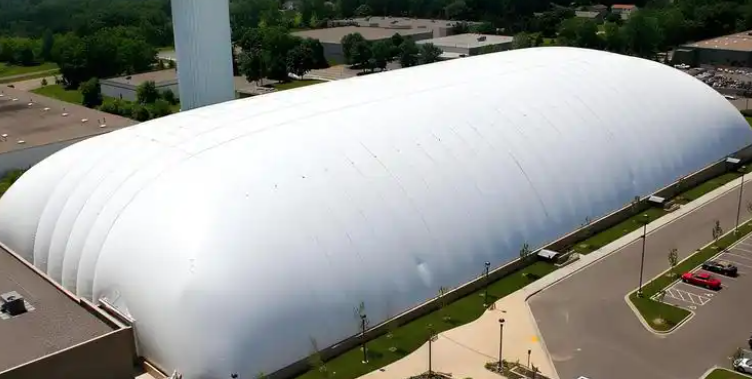
Air-supported structures encapsulate entire coal piles, creating a fully enclosed environment. Wind cannot enter, and coal dust cannot escape. Any dust generated during stacking or reclaiming operations is contained within the membrane; internal sprinkler systems or mist cannons then cause the dust to settle inside the structure. This effectively cuts off the escape route for dust at the source.
Additionally, by keeping rain out, the coal piles remain dry—preserving their calorific value and preventing the generation of leachate. For coal yards, this ensures compliance with environmental regulations while also making sound economic sense.
III. Why are air-supported structures increasingly preferred over steel-structure alternatives?
While steel-structure enclosures can also provide containment, they are more expensive and require longer construction periods. For a coal storage facility spanning tens of thousands of square meters, a steel structure might take over six months to build, whereas an air-supported structure can be completed in just two to three months. For coal storage facilities facing government-mandated deadlines for environmental rectification, time is of the essence.
Coal storage environments are highly corrosive; coal dust, sulfides, and humid air take a severe toll on steel structures. Traditional steel-frame coal sheds require periodic anti-corrosion maintenance—a process that necessitates operational downtime. In contrast, the membrane material used in air-supported structures is inherently corrosion-resistant, eliminating the need for regular anti-corrosion upkeep and resulting in lower long-term maintenance costs.
Air-supported structures are lightweight and place minimal demands on the foundation; they can be installed on existing coal yard surfaces with only minor preparation. Steel structures, being heavy, require complex foundation work—a significant constraint when retrofitting older coal storage sites.
IV. How do air-supported coal sheds perform in practice?
Evidence from facilities already in operation confirms their tangible environmental benefits. Dust concentrations at the site perimeter drop significantly, leading to fewer complaints from the surrounding community and ensuring compliance with environmental inspections. Stacking and reclaiming operations remain unaffected, and vehicle traffic continues as usual. During winter, the interior temperature stays higher than the outside, preventing coal piles from freezing and improving unloading efficiency. In the summer, integrated ventilation systems keep internal temperatures under control.
Air-supported coal sheds are not merely a theoretical concept; they are a mature, proven solution already widely deployed across power plants, coal mines, and ports. For enterprises still struggling with dust emissions at their coal storage sites, this represents a reliable and field-tested option.