Design Services
Arched Tensile Roofs for Mountain Cable Car Stations
Set against a backdrop of rolling, layered mountains, a fluid, expansive series of arched tensile membrane structures rests quietly upon the highland terrain. This roof project for a mountain cable car station utilizes a skeletal tensile membrane system, providing a reliable protective enclosure for cable car equipment within a harsh, rugged environment—a testament to the unique value of tensile membrane architecture in mountain transport infrastructure.

Mountain-based projects have always posed significant engineering challenges. High altitudes, intense solar radiation, extreme diurnal temperature fluctuations, and the constant onslaught of strong winds, dust, rain, and snow place rigorous demands on a building’s envelope. Traditional roofing systems, with their substantial self-weight, require high foundation load-bearing capacity and present significant logistical hurdles regarding material transport and on-site hoisting. In contrast, the lightweight nature of a tensile membrane structure drastically reduces the load on both the foundations and the steel framework, making it an ideal solution for the complex construction conditions found in mountainous terrain. The project employs a multi-span, continuous arched-frame layout; the white membrane is tensioned over the curved steel arches, creating a seamless, undulating surface. The resulting open, column-free interior provides the perfect space for the installation, maintenance, and operation of large-scale cable car machinery.

Unlike ETFE pneumatic cushions, this type of skeletal tensile membrane consists of a fabric substrate with a protective coating. It achieves a stable, curved form through pre-tensioning, offering excellent shading and protection—an ideal choice for cable car stations that require shielding from intense light to safeguard precision mechanical equipment. The membrane surface features a self-cleaning coating; in the dusty, wind-swept mountain environment, rainwater effectively washes away surface debris, maintaining a clean appearance over time and significantly reducing the need for on-site maintenance. Furthermore, the material boasts superior UV resistance and durability, allowing it to withstand the harsh, high-altitude sun and adapt reliably to extreme temperature swings.

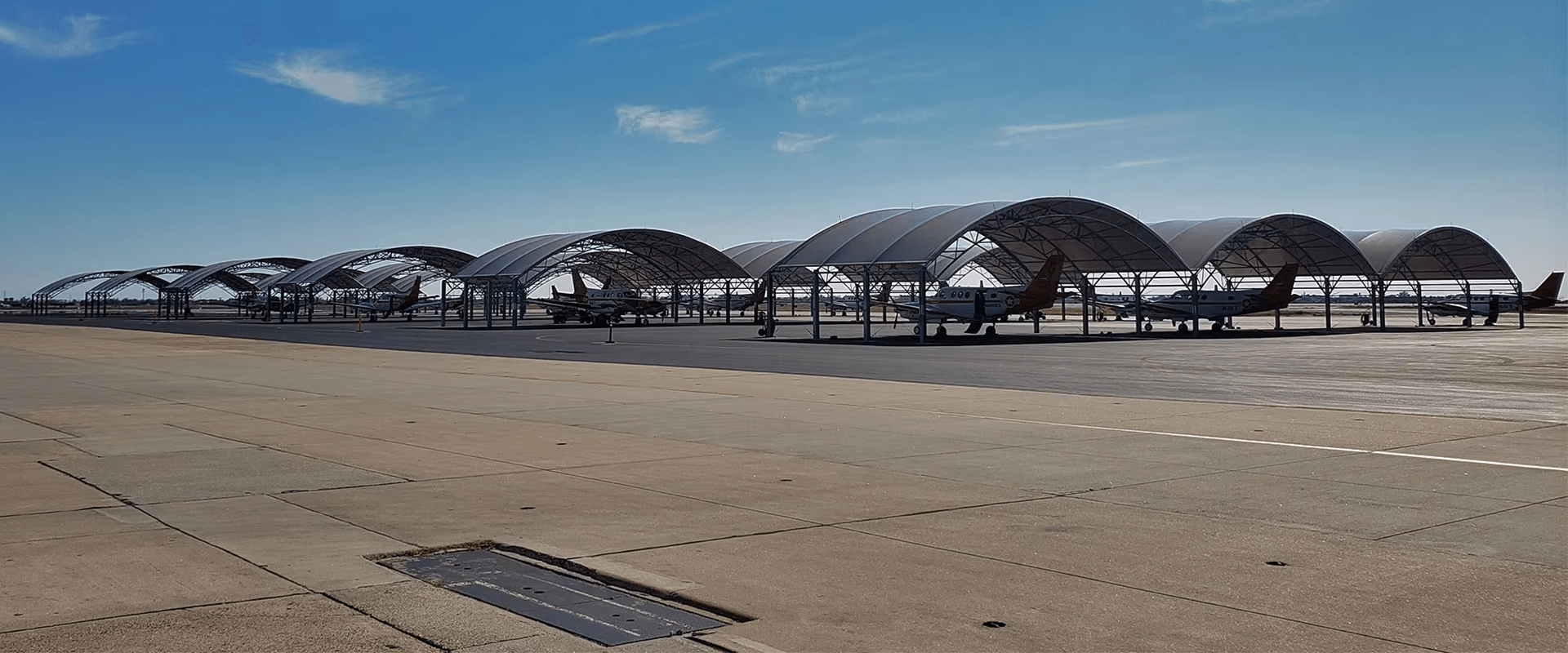
As seen in the construction-site imagery, the dark, curved steel arches are arranged in an orderly fashion, serving as the load-bearing skeleton for the entire roof. The white membrane is stretched taut over this framework, creating a striking contrast between rigidity and flexibility, defined by clean, sharp lines. Set against a backdrop of distant mountains and blue skies, the minimalist, soft white curved surfaces do not disrupt the raw, natural texture of the landscape; instead, they emerge as a distinctly modern architectural signature amidst the mountains. Construction in such a mountainous environment is exceptionally challenging—the limited workspace restricts the use of heavy machinery, requiring workers to position, tension, and secure the membrane material while perched high atop the arched surfaces. The precision of each tensioning point is critical, directly determining the roof’s final form, its stability against wind, and its overall service life.

The continuous arch structure achieves a harmonious balance between mechanics and aesthetics. Its curved profile efficiently sheds wind and snow loads, mitigating risks associated with the accumulation of snow or dust—a design essential for mountainous regions prone to harsh weather. Unlike many tensile structures found in urban landscapes, this project prioritizes functional requirements: providing shelter from sun and rain, protecting cable car machinery, and adapting to the mountain climate—all while using fluid, curved surfaces to imbue the structure with aesthetic grace.

Today, tensile membrane structures have moved well beyond urban settings, finding applications in tourism-related cable car systems, mountain transport infrastructure, and outdoor facilities. By eschewing heavy, cumbersome enclosures, these lightweight structures take root in the wilderness, striking a balance between structural safety, cost-effectiveness, construction feasibility, and visual impact. This mountain cable car station serves as a robust demonstration of tensile membrane architecture in a rugged, high-altitude environment. With a sturdy steel-arch framework draped in a flexible membrane, it provides a stable and reliable shelter for cable car equipment amidst the towering peaks. By aligning the structure with nature and integrating its function into the landscape, this project embodies the unique strength and beauty inherent in tensile membrane architecture.