Design Services
Designing Coastal Tensile Sails for Wind & Salt Spray
While many perceive coastal tensile membrane structures merely as light, sculptural elements within a seaside landscape—providing shade for those gazing out at the ocean—the tensile sail systems installed on such waterfront platforms are, in reality, engaged in a constant battle against a complex, compounding set of erosive forces rarely encountered by inland projects: fluctuating sea breezes, persistent salt spray, significant diurnal temperature variations, and intense ultraviolet radiation reflected off the water. Their aesthetic appeal stems from the graceful expansion of their curved surfaces; however, their true engineering success—or failure—hinges on critical details such as connection nodes, pre-tensioning, corrosion resistance, and form-finding. These are the very aspects most frequently overlooked or obscured by an overemphasis on pure aesthetics in coastal tensile membrane shading projects.
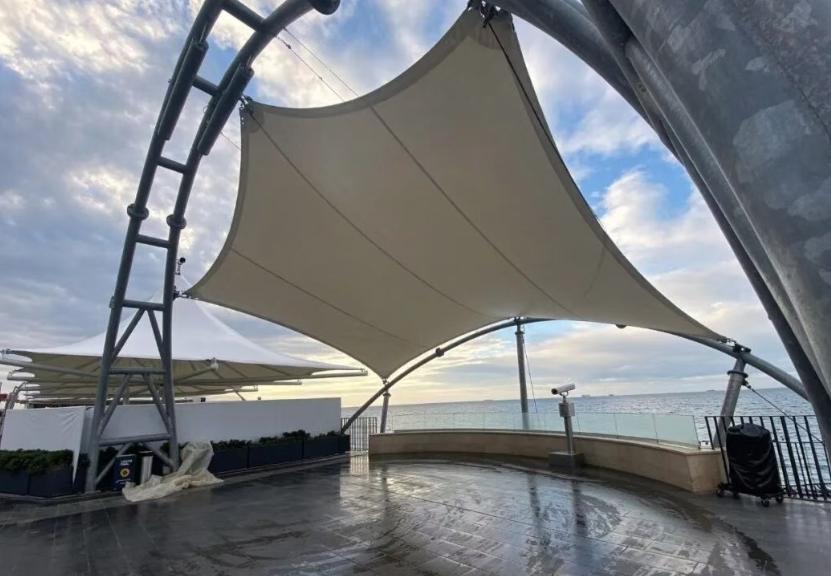
At sunset, looking out toward the sea, the staggered, multi-level tensile sails appear like white-sailed vessels anchored along the cliffside. Arched steel ribs and radial, umbrella-like columns support a continuous, doubly-curved membrane surface. By day, the material softens and diffuses sunlight; by night, backlit, it emits a uniform, gentle glow that harmonizes with the nocturnal seascape. Visually, the structure facilitates a dialogue between architecture and the ocean, framing the view while softening the heavy, rigid presence of the platform itself. Yet, the coastal environment serves as the most demanding proving ground for flexible membrane structures. Sea breezes are not static, stable loads, but rather dynamic, pulsating forces—shifting between offshore winds, onshore winds, and turbulent eddies. These forces cause the membrane to repeatedly lift and depress, subjecting weld seams, cable terminations, and edge-clamping nodes to long-term cyclic fatigue. Furthermore, chloride ions from the seawater—carried by the mist—settle onto the membrane, steel components, and fasteners. Through repeated wet-dry cycles, corrosion begins to take hold, often initiating stealthily within scratches in the protective coatings or deep inside the very crevices that are inherent to tensile construction.

The form-finding process for such a project differs fundamentally from that of standard shading sails in inland parks. While inland designs often prioritize visual form—treating drainage slopes as a secondary technical check—the form-finding for coastal tensile sails must prioritize “salt and water drainage” from the very outset. Once the membrane surface develops slack areas or depressions, rainwater—carrying sea salt—becomes trapped within the folds. As the water evaporates, salt crystals precipitate and adhere firmly to the coating. These crystals continue to absorb atmospheric moisture, creating localized micro-environments with high humidity. This accelerates the hydrolysis and chalking of the membrane coating, while simultaneously causing persistent corrosion within weld seams, leading to a rate of strength degradation far exceeding that seen in typical environments. Consequently, the complex curvature of this design is not merely an artistic flourish; every high point, low point, and cable alignment is strategically engineered to ensure rapid rainwater runoff, leaving no opportunity for salt-laden moisture to settle and crystallize. Nevertheless, material creep remains a long-term risk: under sustained wind loads and temperature cycles, the membrane gradually elongates, causing a loss of pretension. This flattens the intended drainage slopes, inevitably leading to the formation of folds. In many coastal membrane projects, structural issues that emerge after three to five years of service can be traced back to this loss of slope due to creep, rather than the inherent aging of the material itself.

Another, less obvious challenge lies in the anti-corrosion strategy for steel structures and fasteners. In coastal environments, standard hot-dip galvanizing is insufficient to withstand salt spray. Furthermore, the risk of galvanic corrosion—arising from the contact between dissimilar metals—is particularly problematic. When carbon steel arches, stainless steel rigging, aluminum alloy clamping strips, and various grades of bolts come into direct contact, chloride ions act as an electrolyte, forming a galvanic cell that accelerates rusting. During on-site installation, weld seams and areas damaged by grinding become vulnerable points; applying new, large-scale protective coatings during subsequent operation and maintenance is extremely difficult. Many coastal membrane projects merely specify “coastal-grade corrosion protection” on the blueprints, yet lack the necessary detailing—such as component isolation, insulating gaskets, or on-site sealing of damaged areas. By the time rust appears at the base of the steel structure, it has often already spread beneath the coating, making repairs exceptionally costly.

Additionally, cable-membrane coupled resonance—triggered by wind-induced vibrations—presents a unique risk for tensioned membrane structures in coastal locations. In open coastal areas, the absence of surrounding structures leaves the membrane surface susceptible to turbulence-induced fluttering. While this may appear to the naked eye as mere gentle trembling, the continuous, repetitive stress accelerates fatigue in the welded seams and can cause anchor points to loosen. During the form-finding phase, designers must carefully calibrate the distribution of stiffness—utilizing varying levels of pre-tension across different zones to ensure the membrane’s resonant frequencies do not align with those of the wind—rather than simply pulling the material as taut as possible. Excessive tension amplifies thermal stress and increases the risk of the membrane material becoming brittle in cold temperatures; conversely, insufficient tension leads to significant fluttering in the wind, as well as water pooling and wrinkling. Consequently, the acceptable range for pre-tension in coastal tensile structures is far narrower than in inland projects, imposing rigorous requirements on tensioning techniques, on-site temperature management, and the precise sequencing of the tensioning process.

While we often admire such coastal membrane structures for their lightness and poetic quality—frequently categorizing them as mere landscape features—this project reveals a different reality: a coastal tensile sail is not a structure that is “finished” once built. Instead, it functions as a dynamic system requiring continuous tension monitoring, regular inspection of connection points, the removal of salt deposits, and periodic re-tensioning. Its poetic essence is anchored in precise mechanics and corrosion-resistant detailing; the sea breeze and salt spray are in a constant state of eroding its tension. Those gracefully undulating white sails represent a delicate equilibrium, painstakingly maintained by engineering in the face of natural erosion. As visitors sit beneath the membrane, gazing out at the sunset over the sea, they are rarely aware that beneath this soft, curved surface lies an invisible, day-after-day struggle of tension.