Design Services


Tensile Membrane Structure Cost: 7 Modules & Budget Traps
Use this at: project initiation, tender costing and commercial negotiation, when owners, project managers or cost engineers need to judge whether a quotation is reasonable and find legitimate room to reduce cost.
Membrane structure cost is never simply “area × unit price”. Choose the wrong pricing basis or leave out an implicit cost, and the final account can overrun by more than 50%. Membrane structure engineering is a typical non-standard, custom-built category. Quotes in the market vary enormously: some are quoted at RMB 300/m² of projected area, others as high as RMB 3,000/m². The reason is that a membrane structure is a comprehensive mechanical system made of membrane material, steel, cable systems, foundations, design and construction. Peel back the layers and see where the money actually goes. Understanding the seven core cost modules below helps you spot the trap behind a low bid and identify the savings that are genuinely available.

Seven Cost Modules at a Glance
Use this table as the first pass over any quotation. Only the shares and percentages given in the source are stated as numbers; where no fixed share applies, the table names the cost signal instead of inventing one.
| Cost module | Stated share or cost signal | Main cost driver | Budget trap to check |
|---|---|---|---|
| 1. Membrane material and steel | 50%–65% of the total cost | Membrane grade and grammage; steel tonnage (kg/m²), steel grade, anti-corrosion system and fabrication complexity | A quote that says only “rust-proof treatment” instead of hot-dip galvanizing; PTFE specified for a semi-permanent car park |
| 2. Cable systems and connection nodes | 10%–15% of the total cost | Stainless steel cables (304 or 316), precision rigging, clamps, corner plates and edge waterproofing | Hardware, adjusting bolts or edge sealing quietly excluded; seized fittings block future re-tensioning |
| 3. Foundations and civil works | No fixed share; foundation cost can double on soft soil, reclaimed land or an existing roof | Pull-out resistance against wind uplift, ground conditions and the accuracy of embedded bolts | Excavation, reinforcement, concrete and anchor bolts usually outside the supplier’s standard quote |
| 4. Design and form-finding | A technical fee that must not be cut | Form-finding, 50-year wind and snow load analysis, wind tunnel or CFD work, and patterning with pretension compensation | Copied drawings or drawings made “by feel” with no form-finding analysis |
| 5. Installation, lifting and work at height | Scaffolding alone can exceed 10% of the total price, depending on height | Truck cranes, articulated boom lifts, weather windows, specialist tensioning crews and scaffolding | Delay costs while waiting for wind below Beaufort force 4; staged tensioning work treated as ordinary labour |
| 6. Logistics, waste and unforeseen costs | Material utilisation 75%–85%; contingency 5%–10% | Special transport permits, membrane folding and handling rules, nesting/layout efficiency and site obstructions | Overlong or overwide steel without a transport permit; no allowance for uneven existing structures |
| 7. Tax, testing and long-term maintenance | Explicit line items required; warranty may be 1 year or 5 years | Steel and weld inspection, membrane tensile testing, completion acceptance, insurance and warranty services | Warranty length, periodic tension checks and local heat-seal repairs not written into the contract |
Module 1: Membrane Material and Steel — the “Bones and Skin” (50%–65%)
Use this at: material selection, structural scheme review and quotation comparison, when the largest single block of the budget is being fixed.
This is the absolute heavyweight of the cost breakdown. Steel is the skeleton; membrane is the skin. Together they carry wind, snow and other external loads.
Membrane material selection and life-cycle cost
The price span of membrane material is enormous and determines the life-cycle cost of the building.
| Material | Cost and service life | Application in the source |
|---|---|---|
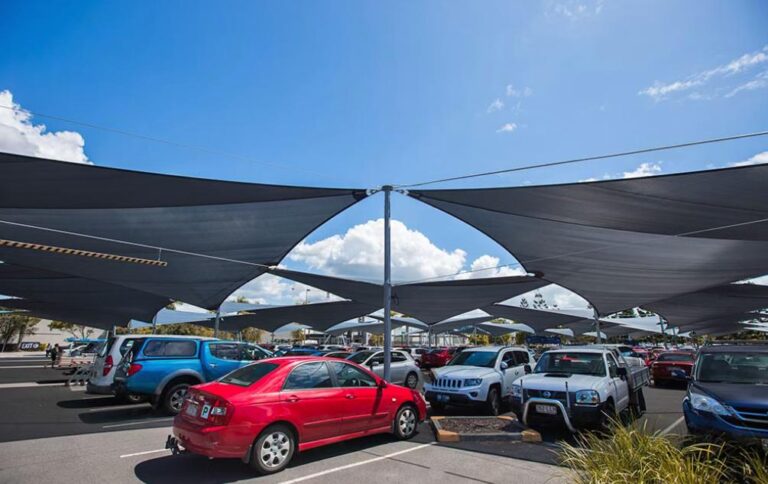
| Ordinary PVC membrane (polyester fibre + PVC coating) | Lowest unit price; typically 10–15 years of life; prone to ageing | Temporary buildings and small car parks |
| PVDF top-coated PVC membrane | A self-cleaning coating is added to the PVC surface; dirt resistance improves | The mainstream choice for small and medium-sized commercial shading |
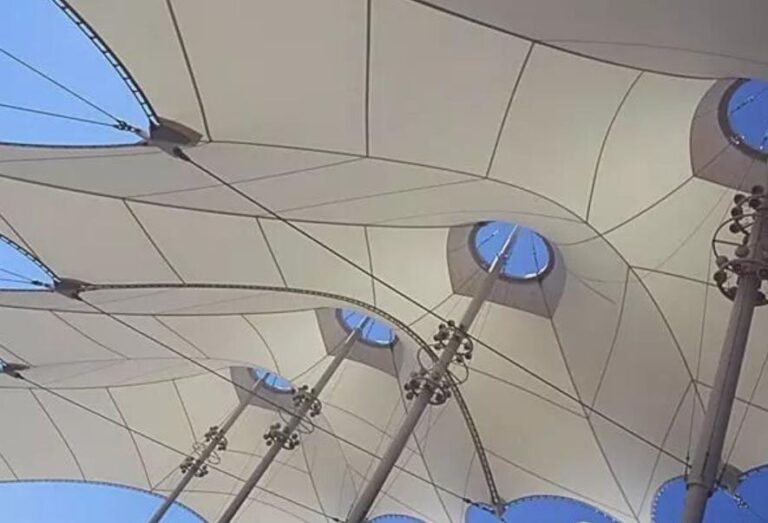
| PTFE membrane (glass fibre + polytetrafluoroethylene) | Several times the cost of ordinary PVC; 25–30 years of life; Class A fire rating; excellent self-cleaning | The standard for large stadiums, high-speed rail stations and permanent public buildings |
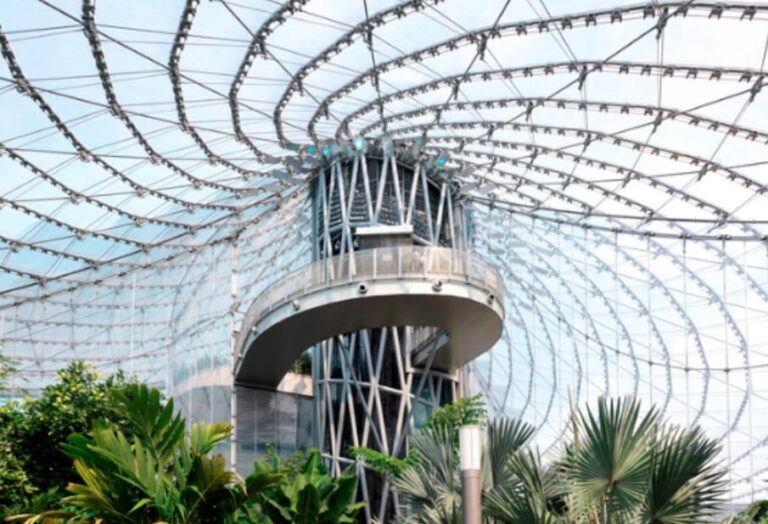
| ETFE membrane (ethylene-tetrafluoroethylene copolymer) | Often made into air cushions; priced by the area of a single membrane panel; requires an inflation control system; extremely expensive | Landmark skylights and botanical garden greenhouses |
Cost-control warning: unit price, grammage and application
Do not look only at the unit price (RMB/m²) — check the grammage too. Even with PTFE, 1,000 g/m² and 1,200 g/m² differ greatly in mechanical performance and price. Using PTFE blindly in a semi-permanent car park doubles the cost; choosing low-end PVC for a permanent landmark in a coastal typhoon-prone area is planting a safety hazard.
Steel tonnage and fabrication process
The larger the span and the more complex the shape — for example an asymmetric free-form surface — the higher the required steel specification and section, and the faster the steel tonnage (kg/m²) rises.
Steel grade
Q235B (ordinary carbon structural steel) and Q355B (low-alloy high-strength steel) are priced differently. Q355B has higher strength and can reduce steel tonnage, but its material unit price is higher.
Anti-corrosion process — the core price difference
Hot-dip galvanizing gives long rust protection but carries a high fabrication fee and can cause distortion. Shot blasting + epoxy zinc-rich primer + fluorocarbon topcoat gives a smoother appearance, but the paint film is easily chipped. When reading a quotation, confirm in writing that it says hot-dip galvanizing. Many low bids say only “rust-proof treatment”, which in practice means two coats of anti-rust paint — and rust starts appearing two to three years later.
Fabrication and material loss
Intersection cutting and curved-section fabrication for irregular steel require heavy machinery, so the fabrication fee is far higher than for standard straight steel members.
Module 2: Cable Systems and Connection Nodes — the Hidden “Cost Assassins” (10%–15%)
Use this at: detailed bill-of-quantities review, especially on first-time membrane structure projects where this line is easy to overlook.
Owners new to membrane structures often ignore this portion, which usually takes 10%–15% of total cost — yet it is a high-frequency source of quality problems.
Cables and rigging
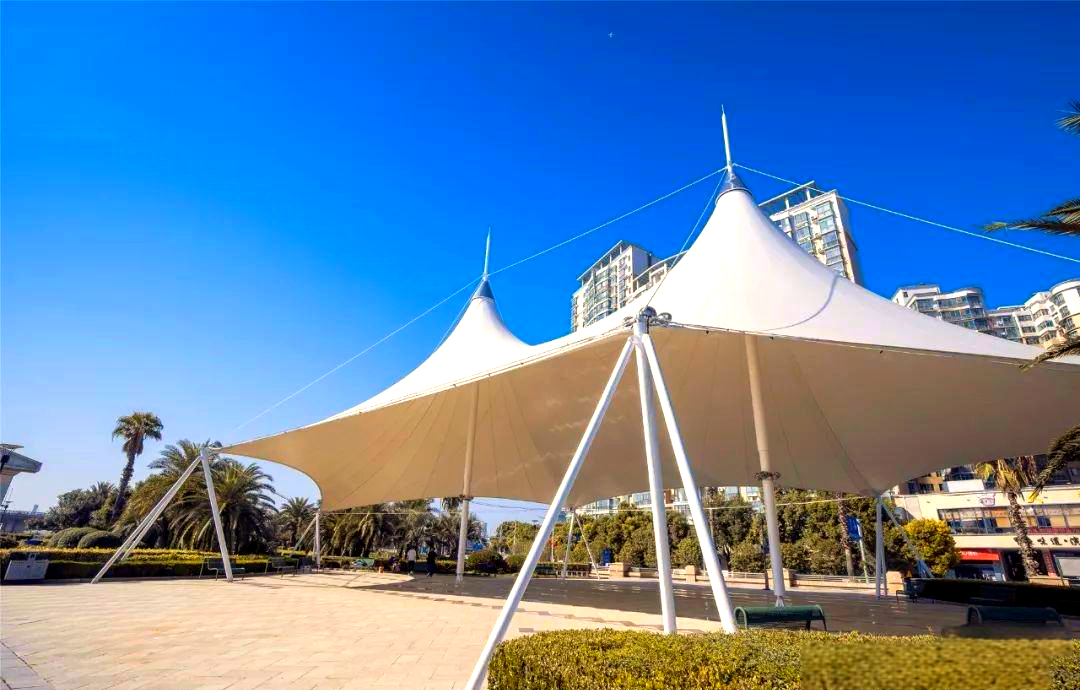
Stainless steel cables such as 304 or 316 are priced by the metre or by the tonne and must meet high tensile-strength requirements. Rigging connectors — adjustable ends, anchors and turnbuckles — are precision-machined parts. Inferior hardware exposed to sun and rain outdoors rusts and seizes easily.
Clamps and membrane corner plates
The membrane is connected to the steel through aluminium alloy clamps or steel plates. Machining accuracy must match the membrane boundary perfectly; a poor fit tears the membrane.
Edge waterproofing and gutters
Valley lines in ridge-and-valley forms, waterproof cover plates at membrane–steel interfaces and downpipe systems are extremely labour-intensive “closing-up” work. Labour here can even exceed the material cost.
Pitfall check: confirm every hardware item
Make sure the quotation includes all hardware, adjusting bolts and edge sealing. Once rigging seizes up, the future re-tensioning made necessary by membrane stress relaxation becomes extremely difficult to carry out.
Module 3: Foundations and Civil Works — the Price of Pull-out Resistance
Use this at: site-condition review and scope negotiation with the membrane supplier and the civil contractor.
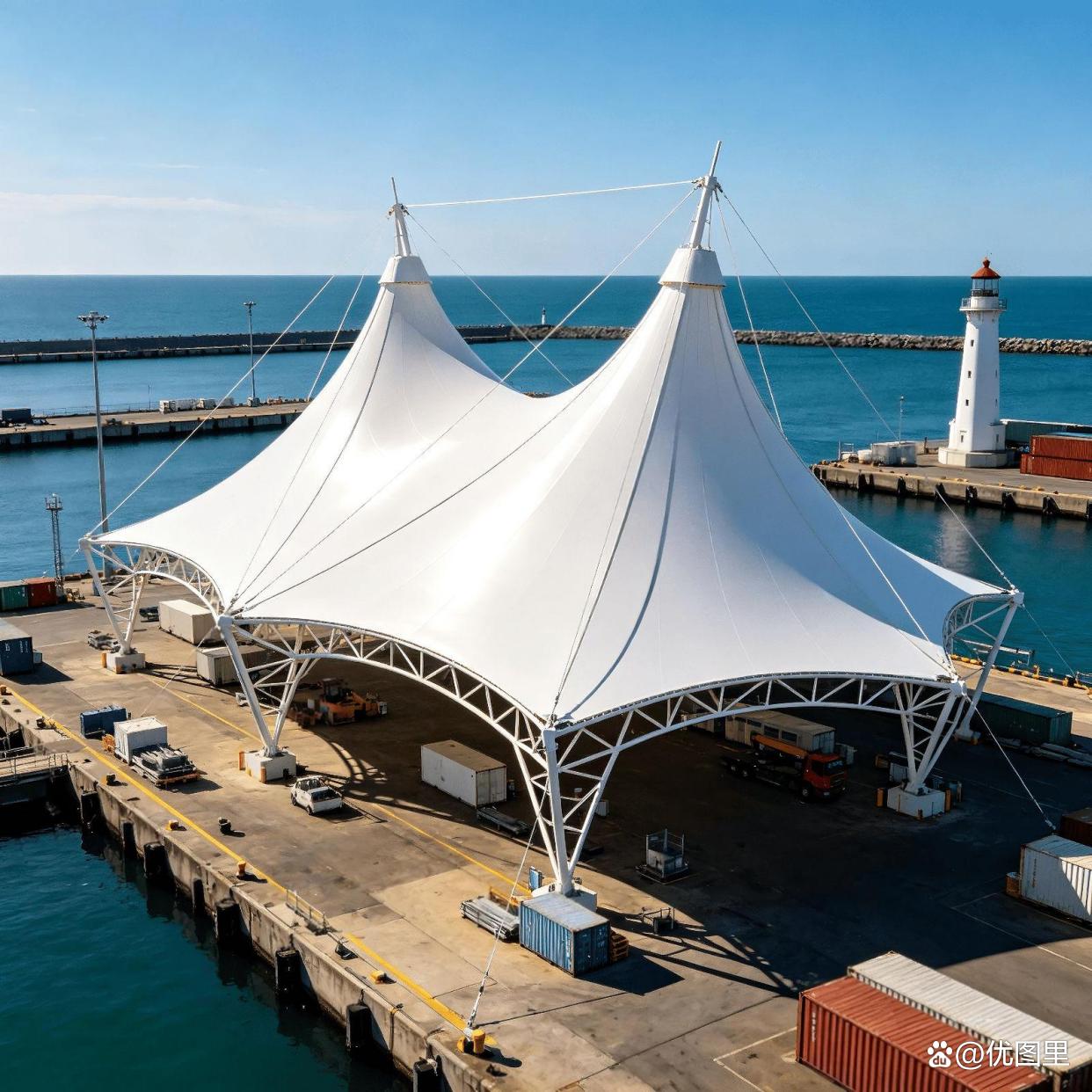
A tensioned membrane places extremely high pull-out demands on its foundations. The membrane surface must be prestressed to hold its shape, and strong wind creates enormous upward suction — wind uplift.
Geotechnical conditions
With good ground, such as hard clay or rock, an ordinary reinforced-concrete independent footing is sufficient. On soft soil, reclaimed land, or the roof of an existing building — where ballast or chemical anchors into the existing structure are needed — foundation cost multiplies.
Accuracy of embedded parts
Tensioned membranes are extremely sensitive to installation accuracy. If an embedded bolt for a steel column deviates by more than 1 cm, serious stress concentration develops in the membrane. Remedial work with chemical anchors later carries high cost and high risk.
Pitfall check: civil works are usually excluded
Excavation, reinforcement, concrete and anchor bolts are often outside the membrane supplier’s standard quotation. A low bid most probably means “foundations not included”; another civil crew arrives later and charges for that work a second time.
Module 4: Design and Form-finding — the Technical Premium You Cannot Cut
Use this at: design-scope confirmation and technical due diligence, before any contract is signed.
A membrane structure is not “a few sheets of fabric draped over a frame”. It requires rigorous structural calculation.
Form-finding
Software such as Easy or 3D3S is used to calculate how a minimum surface can cover the maximum area and to find the best load-bearing form.
Load analysis: wind, snow and earthquake
The analysis must use local 50-year wind pressure and snow pressure. Large or complex projects also need wind tunnel testing (CFD simulation).
Patterning
Patterning unfolds a 3D curved surface into 2D membrane panels while allowing for pretension compensation.
Pitfall check: never skip form-finding
Some small workshops simply reuse existing drawings or draw by feel, leaving out form-finding analysis. In extreme weather such a structure is highly prone to membrane flutter and tearing, or to steel yielding and collapse. This is one cost that must never be cut.
Module 5: Installation, Lifting and Work at Height — the Hard Cost
Use this at: method-statement review and programme planning, especially for coastal or windy-season work.
Although membrane material is light, the technical requirements during installation are far higher than for an ordinary steel structure.
Crane and machinery shifts
Unfolding and lifting the membrane requires large-tonne truck cranes and articulated boom lifts.
Weather-window cost
The membrane must be unfolded only below Beaufort force 4. This is a hard constraint, not a recommendation. If the project is coastal or built during the windy season, the delay cost of waiting for good weather must be calculated in advance.
Specialist tensioning labour
Specialist tensioning workers apply force in stages according to stress-monitoring data, for example readings from a tension gauge: 80% on day one, 90% on day two and 110% on day three to offset later relaxation. Their daily rate is far above that of ordinary masons.
Scaffold erection and dismantling
Depending on height, full-scaffold or cantilever-scaffold work can exceed 10% of the total price.
Module 6: Logistics, Waste and Unforeseen Costs
Use this at: logistics planning, material take-off review and contingency setting.
Oversize and sensitive logistics
Membrane structure steel members are often overlong or overwide and need special transport permits. Folded membrane is compact but must not be heavily compressed and must never touch sharp objects; transport cost is therefore not low.
Fabrication waste
Because cutting is constrained by roll width and curved geometry, material utilisation is usually only 75%–85%. The quality of the nesting/layout design directly determines this hidden cost.
Contingency allowance
Obstacles not found during site survey and uneven existing building structures all force changes on site. Reserve 5%–10% as a contingency.
Module 7: Tax, Testing and Long-term Maintenance
Use this at: final quotation comparison and contract drafting, where aftercare promises must become measurable obligations.
Testing and inspection
These include steel flaw detection, weld inspection, membrane tensile testing and structural acceptance after completion.
Insurance
Contractor’s all-risks insurance for work at height and third-party liability insurance. Membrane construction carries high risk, so a reputable large supplier’s quote will necessarily include this cost.
Warranty and maintenance
Does the quote promise a 1-year or a 5-year warranty? Does it include periodic tension inspection and local heat-seal repair? These hidden aftercare costs must be quantified in black and white when the contract is signed.
Supplier Quote Checklist: Five Questions to Ask
When comparing quotations, never look only at the final total price or a simple “unit price per square metre”. Hand this guide to suppliers, require them to quote against a unified itemised list, and confirm these five questions face to face.
1. Measurement basis
Is the price based on projected area or developed area? Developed area is usually 1.2–1.4 times the projected area — a huge visual price difference. Are gutters and flying edges (overhangs) included?
2. Material brands and parameters
Which steel mill supplies the steel? Which membrane brand — for example Serge Ferrari, Mehler, or domestic Shenzhen Zhongtian — with what grammage and what coating? Are the cables 304 or 316?
3. Scope of the lump sum
Does the quote include foundation civil excavation? Embedded parts? All rigging hardware? Crane machinery charges?
4. Design basis
Will the supplier provide a complete 3D form-finding model and load calculation report, stamped by a qualified membrane structure design unit?
5. Tax and construction schedule
Will a 13% VAT special invoice be issued? What is the committed construction period, and how will it be extended in force majeure events such as typhoons or rainstorms?
How the Modules Fit Together
Membrane material, steel, cables, foundations, design, installation and aftercare are not independent line items: the membrane grade sets the prestress, the prestress drives cable forces and foundation pull-out demand, the geometry drives steel tonnage and patterning, and the site and weather drive the installation method. A low number in one module is frequently a cost moved into another — or omitted altogether. Only when the budget is broken down to this level of granularity does the quotation become a real cost model that can support decisions and financial approval. Compare like with like, make every exclusion explicit, and price the technical work rather than treating it as a free extra.
Frequently Asked Questions
Why do tensioned membrane structure quotes range from RMB 300 to RMB 3,000 per square metre?
Because a membrane structure is a custom mechanical system made up of membrane material, steel, cable systems, foundations, design and installation. A quoted price based on projected area may be RMB 300/m2 or as high as RMB 3,000/m2, depending on what is included and how the area is measured.
What share of the budget do membrane material and steel take?
Membrane material and steel make up 50%-65% of the cost. They are the skin and bones of the system and jointly carry wind, snow and other external loads.
Why is the foundation often missing from a low membrane structure bid?
Civil works such as excavation, reinforcement, concrete and anchor bolts are often outside the membrane supplier’s standard quotation. A low bid usually means foundations are excluded, and a separate civil contractor charges again when work starts on site.
Can I save money by skipping form-finding analysis?
No. Form-finding, load analysis and patterning are required. Small workshops that copy existing drawings or draw by feel omit the analysis, and in extreme weather the membrane can flutter and tear or the steel can yield and collapse. This is a cost that must not be cut.
What is the wind limit for unfolding a membrane surface?
The membrane must be unfolded only below Beaufort force 4. This is a hard constraint, not a recommendation. In coastal areas or during the windy season, the cost of waiting for a suitable weather window must be included in the schedule and budget.
How much contingency should a membrane structure budget include?
Reserve 5%-10% for the unforeseen: obstacles not found during site survey, uneven existing structures and other conditions that force changes on site.