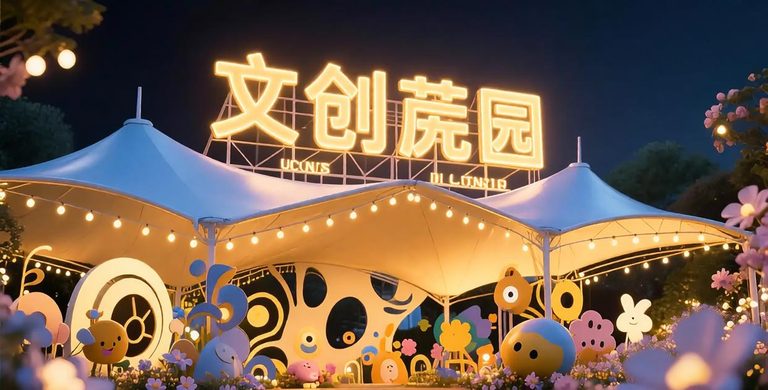
Design Services


Choosing Membrane Structures: Frame, Tension or Air?
Frame vs Tension vs Air-Supported Membrane Structures: A Practical Selection Guide
Use this at: the concept stage, when the owner and the designer need to settle on a technical route before anything else. Choose the wrong structural system and even the most expensive membrane fabric cannot make up for it later.
Membrane structures fall into three mainstream types by load-bearing mechanism: frame-supported, tensioned (cable-membrane), and air-supported. Their span capability, cost structure, and maintenance logic are completely different. There is no such thing as “which one is better” — only “which one is least wrong under this project’s conditions”.
Quick Comparison: Three Membrane Structure Types Side by Side
| Dimension | Frame-supported | Tensioned (cable-membrane) | Air-supported (air dome) |
|---|---|---|---|
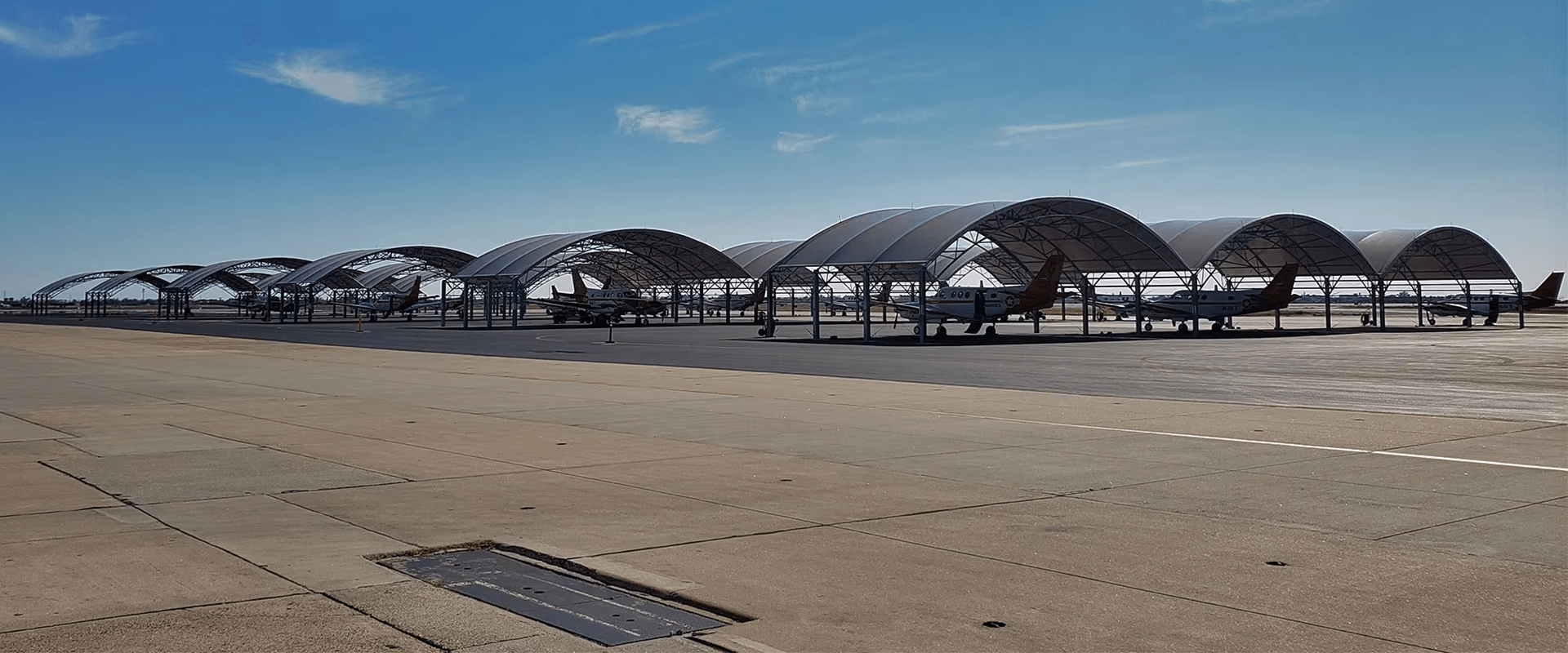
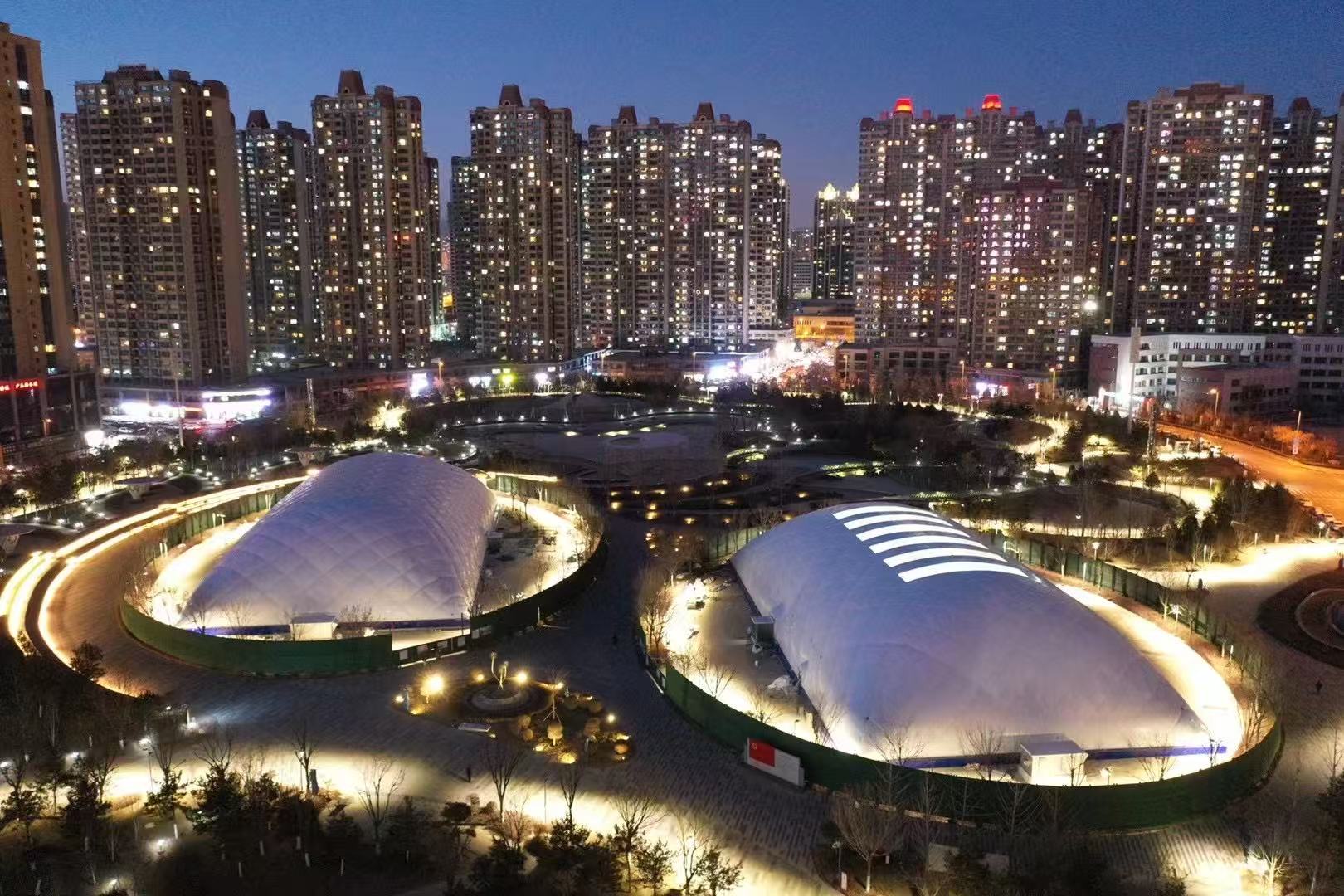
| Load-bearing logic | A rigid steel frame carries the load; the membrane mainly acts as a weatherproof cover. | Cables and masts apply prestress; the membrane surface itself participates in load-bearing. | Continuous internal positive pressure holds up the membrane. |
| Practical span for stands / cantilevers | 6-12 m is the economic range. | Cost-effectiveness emerges at 12-20 m. | Suited to large, column-free spaces. |
| Form freedom | Limited by the frame geometry; moderate expressive range. | Highest; allows fluid, sculptural curves. | Relatively uniform form, dominated by overall domes. |
| Construction threshold | Lowest; mature, well-understood technology. | Highest; form-finding and tensioning are demanding — “a poorly tensioned membrane can fail faster than a frame-supported one”. | Moderate, but requires fans and control systems. |
| Cost profile | Best value; driven mainly by steel cost. | Noticeable design and construction premium; usually the highest overall cost. | Moderate upfront investment; operating energy is the hidden major cost. |
| Maintenance burden | Simple maintenance. | Requires regular checks of prestress and connections. | Needs 24/7 uninterrupted air supply; electricity and fan maintenance are ongoing. |
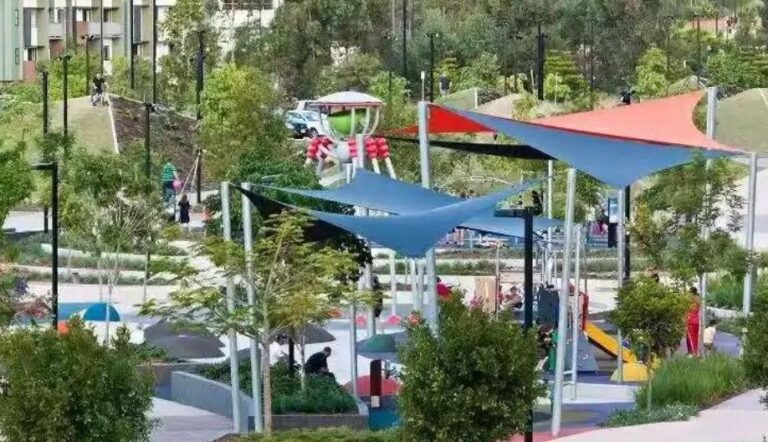
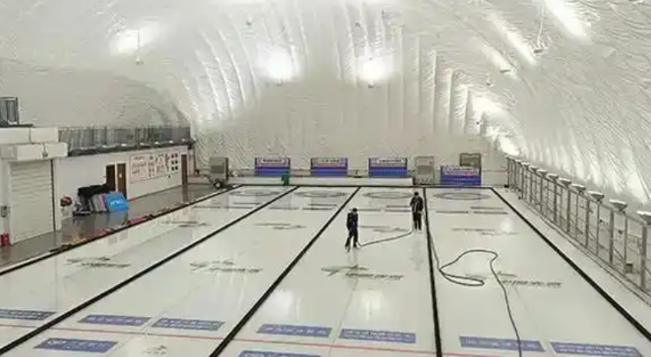
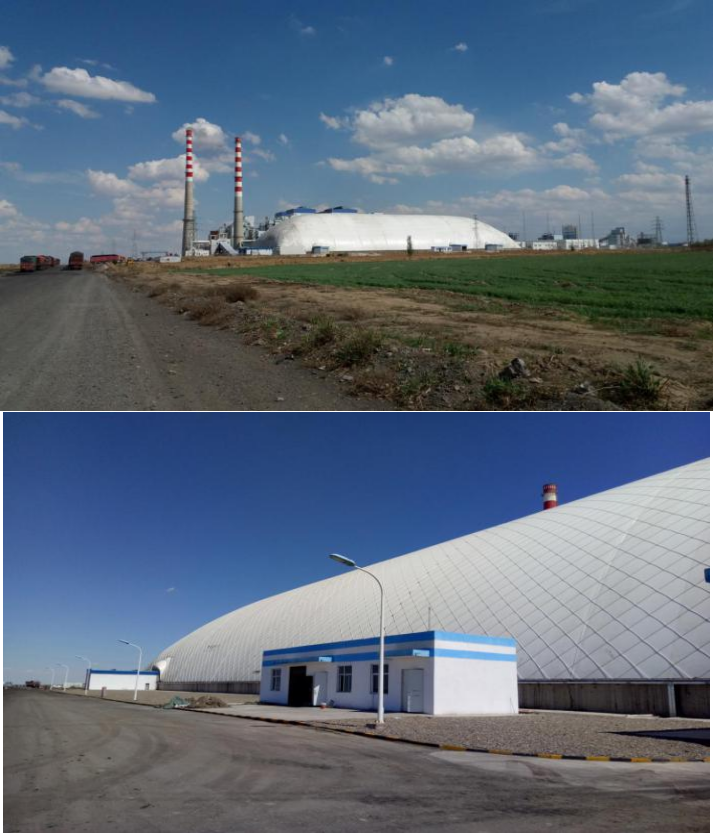
| Typical applications | Car parks, bus shelters, small venue entrances, industrial buildings. | Stadium stands, landscape pavilions, long-span public buildings. | Coal-yard enclosures, temporary venues, emergency shelters. |
How to Choose: A Priority-Ordered Decision Framework
First question: is the project permanent or short-term / temporary?
Permanent buildings should favour frame-supported or tensioned systems. Temporary exhibitions and emergency shelters can consider air-supported structures, but you must accept the operating cost of a continuous air-supply system.
Second question: is form a core requirement?
If the membrane itself has to carry landmark expression, the tensioned system offers the highest formal ceiling. If function comes first and form is secondary, the frame-supported system offers better cost certainty and construction certainty.
Third question: does the maintenance team have professional capability?
Air-supported systems need continuous involvement from a specialist maintenance team. Frame-supported systems impose the lowest day-to-day maintenance demand. Tensioned systems sit in between, but prestress testing and connection inspections cannot be skipped.
The easily overlooked cross-constraint: 15 m and 500 m²
The free support span of the membrane should not exceed 15 m, and a single membrane panel should not cover more than 500 m². Beyond that, cables must divide the membrane surface into smaller units. Even if you choose a tensioned system, you cannot cover everything with one large sheet — boundary cable layouts and panel division must be considered during system selection.
Part 2 — From Cutting to Tensioning: Tensioned Membrane Construction Step by Step
Use this at: the tensioned membrane system has already been selected and you need to understand the sequence of site installation, key control points, and common risks.
The real challenge of tensioned membrane construction is not “hanging the fabric”, but controlling the sequence and magnitude of tensioning while the membrane takes its final form. Under-tensioning leads to ponding and flutter; over-tensioning or a wrong sequence causes stress concentration and tearing. The steps below follow the site timeline.
Step 1: Foundations and embedded anchors
Excavate the foundation pit, place the embedded anchors, pour the reinforced concrete foundation, and cure it. The positioning accuracy of the embedded anchors directly affects later steel and membrane-corner installation. A deviation left uncorrected at the foundation stage leaves almost no room for remediation once tensioning begins.
Step 2: Steel frame installation
After the steel arrives on site, grind off rust, apply anti-rust primer and topcoat, then complete the welded assembly. Some frames cannot stand on their own: external tie cables must be installed at the same time and held temporarily with guy ropes. A frame that can stand by itself is erected independently, providing a stable boundary for later membrane installation.
Step 3: Membrane fabrication and site preparation
The membrane is cut, sewn, and waterproofed in the factory to the design drawings, then folded, packed, and shipped to site. Before unfolding, clear the work area, lay protective material, and have crews wear soft-soled shoes so hard objects never touch the membrane surface.
Step 4: Membrane unfolding and temporary fixing
Unfold the membrane only when wind force is no greater than Beaufort 4. After unfolding, punch holes, thread steel cables, install membrane-corner gusset plates or clamping plates, and tie a temporary rope net to the supporting structure. Lifting can use multi-point overall hoisting or sectional lifting, with corner points temporarily fixed first.
Step 5: Tensioning and forming — the most critical stage
Tension in batches, controlling both speed and magnitude. A common site practice is: tension to 80% of the design requirement on day one, to 90% on day two, and then over-tension to 110% on day three to compensate for in-service loss of membrane stress. During tensioning, locally adjust corners and wrinkled areas so the surface stays smooth and free of ponding risks. Tensioning too quickly damages the material, so the over-tensioning magnitude must be determined from the characteristics of the membrane.
Step 6: Final fixing and closeout
Permanently fix the membrane surface and connections, install the rainwater system and complete the waterproof covering, then clean both the inner and outer membrane surfaces. Completed work must be protected against damage from subsequent overlapping trades.
Three high-frequency risks during construction
Risk 1: tensioning sequence coupled with steel erection accuracy
When a membrane unit has non-adjustable boundaries, steel erection accuracy must be extremely high: membrane tensioning cannot “absorb” the accumulated tolerances of the steel structure.
Risk 2: the wind window
Beaufort 4 is a hard constraint, not a recommendation. An unfolded membrane is extremely wind-sensitive; gust-induced flutter can cause initial damage to the membrane or its connections before tensioning is complete.
Risk 3: judging the over-tensioning amount
110% is not a universal constant. It must be determined from the membrane type, the project’s local climate, and service conditions. PVC and PTFE behave differently in stress relaxation, so copying the number is risky.
Part 3 — PVC, PTFE, ETFE: Three Material Routes and One Hard Rule
Use this at: the structural system is settled and you are comparing membrane materials against the budget.
The differences between the three mainstream membrane materials come down to a trade-off among service life, light transmission, and cost. No option wins across the board, and the price of a wrong choice usually starts to show only five years later.
Three material routes at a glance
PVC route: value first, with periodic replacement accepted
The base fabric is woven polyester, double-coated with PVC; some products add a PVDF topcoat to improve self-cleaning. Typical service life is 10-15 years, light transmission 10%-20%, Class B flame resistance, flexible and easy to install, with a wide choice of colours. Suitable for small and medium projects such as car parks, EV charging canopies, stand shading, and temporary structures. Not suitable for permanent landmarks, highly corrosive environments, or roofs expected to stay maintenance-free for more than 20 years. Ageing of the coating under long-term UV exposure is a known weak point, and coastal salt spray shortens life further.
PTFE route: one investment, then left alone
Ultra-fine glass-fibre fabric coated with polytetrafluoroethylene; design life 25-30 years, Class A non-combustible, excellent self-cleaning (rain washes surface dust away), and resistant to UV and acid/alkali corrosion. Suitable for large stadiums, convention centres, high-speed rail stations, airport terminals, and highly corrosive settings such as chemical wastewater tanks and coastal salt-spray zones. The trade-off: a price far above PVC, a stiffer membrane easily damaged by folding, and more demanding transport and tensioning workmanship.
ETFE route: made for daylight, but not a drop-in “ordinary membrane”
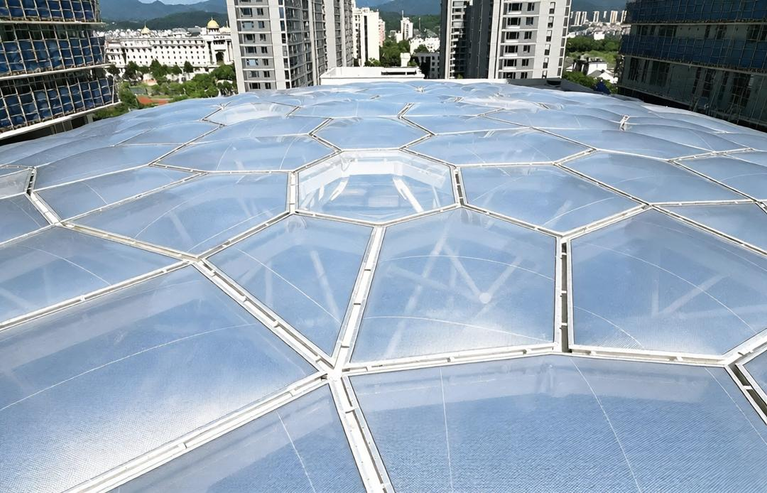
ETFE is a pure fluoropolymer film with no woven base fabric: light transmission 85%-95%, extremely light, self-cleaning, and a service life of 25-30 years. It cannot simply replace conventional tensioned membrane fabric. In practice it is mostly built as multi-layer inflated cushions relying on cushion or cable-net systems, is easily punctured by sharp objects, and needs an inflation control system. Suitable for landmark skylights, botanical garden greenhouses, and shopping-mall atrium roofs; not suitable for ordinary car parks or standard shading.
One hard rule: start with the project’s local climate
In rainy, humid, or coastal high-salt-spray regions, choose PTFE or ETFE first to avoid accelerated PVC ageing from prolonged moisture. In high-UV regions, avoid standard PVC — choose PVC with a PVDF topcoat or go directly to PTFE. In high-traffic public areas, a membrane with poor self-cleaning means higher long-term cleaning costs; the low-maintenance advantage of PTFE/ETFE partly offsets the initial price gap.
Cost ranking: full-package reference including the steel frame
A conventional PVC tensioned membrane project costs roughly 350-800 CNY/m²; a PTFE project roughly 1,000-2,500 CNY/m²; ETFE cushion systems sit in a different cost bracket altogether. Before comparing quotes, align the basis: projected area or developed area, whether steel and foundations are included, whether tax and hoisting are included. Otherwise the numbers are not meaningfully comparable.
Part 4 — Membrane Maintenance and Replacement: Grade the Problem, Don’t Just “Wash It Periodically”
Use this at: the project is already in service and you need to establish an O&M strategy or decide whether to repair or replace.
Two extremes are the enemy of tensioned membrane maintenance: “fix it only if it breaks”, which lets a small hole grow into a large tear, and “replace the whole membrane for any damage”, which is unnecessary waste. A genuinely workable framework grades the response by damage severity.
Routine inspection: quarterly, plus immediately after extreme weather
Inspect three lines: the membrane (tears, punctures, coating loss, wrinkles — focus on seams); the steel structure (loose bolts, cracked welds, corrosion); and drainage (blocked gutters and downpipes). Clean at least twice a year with a neutral cleaner (pH 6-8) and a soft brush; avoid aiming high-pressure water jets directly at seams.
Graded response: where repair, partial replacement, and full replacement draw the line
Grade 1 (repairable): holes under 50 mm in diameter
Heat-seal a dedicated repair patch over the hole. Never substitute ordinary adhesive — adhesives fail quickly under UV exposure and temperature cycling.
Grade 2 (local repair): damage under 10% of the whole membrane
Hot-weld a patch of the same membrane material at high temperature, and add a weather-resistant sealing layer over the weld. Key constraints: no ordinary adhesive, and the repair material must be compatible with the original.
Grade 3 (full replacement recommended): damage over 30%, or over 15 years in service
At this point the marginal benefit of local repair is very low, and the tension difference between old and new membrane can lift an entire membrane panel under extreme conditions such as a typhoon.
Two underestimated supporting issues
Pretension decays; it is not fixed once installation ends
Check membrane tension every 2 years; a deviation beyond ±10% needs prompt adjustment. When adjusting tension, also check whether the steel frame has deformed — the two are coupled.
Steel corrosion decides whether the membrane reaches its design life
Membrane damage is often only the visible symptom; corroded steel connections and failed welds are the real structural problem. Grind rusted areas thoroughly down to bare metal, then apply a complete primer-plus-topcoat corrosion system. Painting directly over unprepared rust will show rust again within six months. Proper maintenance typically extends the overall service life of a membrane structure by 3-5 years.
How the Four Guides Fit Together
The four parts use different formats. Part 1 uses a cross-comparison table plus a decision tree to quickly rule out unsuitable routes at the selection stage. Part 2 uses a timeline, breaking construction into checkable milestones. Part 3 uses three material routes plus one hard rule, turning material selection from a list of parameters into a weighing of trade-offs. Part 4 replaces a generic maintenance checklist with damage grading, answering directly: when to repair and when to replace. If you would like any part adjusted in depth or aimed at a different reader, let me know.
Frequently Asked Questions
Which membrane structure type offers the best value?
Within its economic span range of 6-12 m, the frame-supported system offers the best value, with cost driven mainly by steel. Tensioned systems carry a noticeable design and construction premium and usually have the highest overall cost. Air-supported systems have moderate upfront investment, but operating energy is a hidden major cost.
At what span does a tensioned membrane become cost-effective?
A tensioned (cable-membrane) system shows its cost-effectiveness at spans of roughly 12-20 m, where the membrane’s participation in load-bearing offsets the higher form-finding and tensioning demands.
Can a tensioned membrane be tensioned in a single pass?
No. Tensioning is done in stages with controlled speed and magnitude — commonly 80% of the design requirement on day one, 90% on day two, and 110% on day three. The over-tensioning value must be set according to membrane type and must not be copied as a universal constant.
What wind limit applies when unfolding a membrane?
Beaufort force 4 is a hard limit, not a recommendation. An unfolded membrane is extremely wind-sensitive, and gust-induced flutter can damage the membrane or its connections before tensioning is complete.
When should a tensioned membrane be fully replaced rather than repaired?
Full replacement is recommended when the damaged area exceeds 30% of the whole membrane, or when the membrane has been in service for more than 15 years. Local repair then has very low marginal benefit, and the tension difference between old and new membrane can lift an entire panel under extreme conditions such as a typhoon.
How often should membrane pretension be checked?
Check membrane tension every 2 years. A deviation beyond ±10% needs prompt adjustment, and the steel frame must be checked for deformation at the same time because the two are coupled.